
Leptobasis vacillans
Hagen, 1877
Red-tipped Swampdamsel
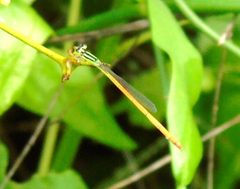
Leptobasis vacillans is a in the Coenagrionidae, commonly known as the Red-tipped Swampdamsel. It occurs across the Caribbean, Middle America, and South America, with records from Oaxaca and other regions. As a member of the Leptobasis, it is associated with swampy . The species was described by Hagen in 1877.
Pronunciation
How to pronounce Leptobasis vacillans: /ˌlɛptoʊˈbeɪsɪs ˈvæsɪˌlænz/
These audio files are automatically generated. While they are not always 100% accurate, they are a good starting point.
Identification
Members of Leptobasis are distinguished from other Coenagrionidae by their slender, elongate and relatively long legs. The specific epithet "vacillans" and "Red-tipped Swampdamsel" suggest the abdomen may have red terminal segments, though this requires confirmation. Separation from such as L. melinogaster and L. guanacaste likely depends on abdominal color pattern and the extent of red or dark markings on terminal segments.
Images
Habitat
Associated with swampy or marshy freshwater , as indicated by the "Swampdamsel" and -level .
Distribution
Recorded from Oaxaca (Mexico), the Caribbean, Middle America, and South America.
Similar Taxa
- Leptobasis melinogaster with overlapping distribution; distinguished by abdominal color pattern, particularly the extent and intensity of dark markings versus red on terminal segments.
- Leptobasis guanacaste in the same region; separation based on subtle differences in abdominal pattern and possibly size.