
Leptobasis lucifer
(Donnelly, 1967)
Lucifer Swampdamsel
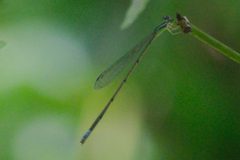
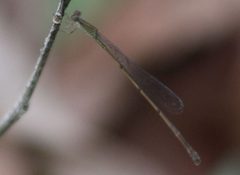
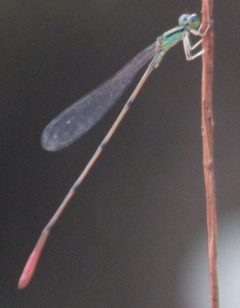
Leptobasis lucifer is a in the Coenagrionidae. It is relatively long and slender compared to other . The is found in swampy woodland in Central America, southern Mexico, and locally in southern Florida. Males are distinguished by black striping on a green and a bright red patch near the end of the . Females exhibit considerable color variation, ranging from dull greenish-brown to blue, reddish-orange, or green with a blue abdominal ring.
Pronunciation
How to pronounce Leptobasis lucifer: //ˌlɛptəˈbeɪsɪs ˈluːsɪfər//
These audio files are automatically generated. While they are not always 100% accurate, they are a good starting point.
Identification
Males can be distinguished from other Leptobasis by the combination of black-striped green and bright red abdominal patch. Females are more difficult to identify due to color variability; the large ovipositor is a useful diagnostic feature. Immatures of both sexes show distinctive pale blueish coloration absent in .
Images
Habitat
Swampy woodland , particularly cypress swamps. Individuals hunt near trees, scanning and hovering around leaves.
Distribution
Central America, southern Mexico, and locally in southern Florida.
Behavior
Hunts near trees, scanning and hovering around leaves in search for prey.
Ecological Role
in swamp woodland .
Similar Taxa
- Other Leptobasis speciesSimilar body form and preferences; distinguished by male color pattern and female ovipositor .
More Details
Taxonomic history
Originally described as Chrysobasis lucifer by Donnelly in 1967, later transferred to Leptobasis.
Sources and further reading
- BugGuide
- Wikipedia
- GBIF taxonomy match
- iNaturalist taxon
- NCBI Taxonomy
- Catalogue of Life
- Summer nights and Lucifer’s lights – Lightning bugs, Lampyridae — Bug of the Week
- The “black bringer of light” | Beetles In The Bush
- Spooky eyes on the Stygian rainforest floor: Headlight beetles, fire beetles, Pyrophorus spp. — Bug of the Week
- bee | Blog
- Just in time for the 4th of July: Firefly fireworks - Lampyridae — Bug of the Week
- Fireflies are busy flashing for mates! Lampyridae spp. — Bug of the Week