
Enallagma exsulans
(Hagen, 1861)
Stream Bluet
Enallagma exsulans, commonly known as the Stream Bluet, is a of in the Coenagrionidae. It is distinguished from many other bluet species by its strong association with flowing water rather than still ponds and lakes. The species ranges across much of eastern and central North America.
Pronunciation
How to pronounce Enallagma exsulans: //ɛnˈæl.əɡ.mə ɛkˈsuː.lænz//
These audio files are automatically generated. While they are not always 100% accurate, they are a good starting point.
Identification
Distinguished from other bluet (Enallagma spp.) primarily by preference for moving water. Differs from the Familiar Bluet (E. civile) and other pond-dwelling by its occurrence along streams and rivers. Lacks the blue-tipped common in many . Identification to species level typically requires examination of male terminal appendages.
Images
Appearance
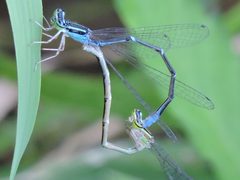
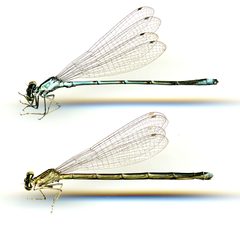
measure 29–37 mm in length. Like other bluet , males typically exhibit blue coloration on the . The lacks the blue abdominal tip found in many other Enallagma species. Overall body form is slender with narrow, transparent wings held together above the body when at rest.
Habitat
Most commonly found along small to medium-sized rivers and streams with moderate current. Occasionally occurs at lake margins. Associated with vegetated shorelines where perch on emergent vegetation.
Distribution
Eastern and central North America. Present in the United States and Canada, with records from Vermont and throughout much of the ' range.
Diet
are aerial capturing small flying insects. Larvae are aquatic predators feeding on small including mosquito larvae.
Life Cycle
Hemimetabolous development with aquatic larval stage (naiad) and terrestrial stage. are deposited on submerged aquatic vegetation; females may submerge completely to oviposit. Larval development occurs in flowing water.
Behavior
perch on vegetation near water, often hanging from stems. Males and females fly in tandem during mating; males release females when females submerge to deposit . Adults are active fliers that hunt prey on the wing.
Ecological Role
and larvae function as in aquatic and riparian . Larvae may serve as indicators of stream health.
Similar Taxa
- Enallagma civileFamiliar Bluet is similar in appearance but prefers ponds and lakes rather than flowing water; also typically has blue-tipped
- Other Enallagma speciesMany overlap in coloration but differ in preference (still water vs. streams) and male terminal appendage
More Details
Taxonomic history
described by Hagen in 1861; originally placed in Agrion. Rosser Garrison published a taxonomic revision of the genus Enallagma in 1984 that included this species.
Sources and further reading
- BugGuide
- GBIF taxonomy match
- iNaturalist taxon
- NCBI Taxonomy
- Catalogue of Life
- Dragonfly Enthusiasts, Unite! Open House Set Nov. 6 at Bohart Museum | Bug Squad
- Know Your Dragonflies! | Bug Squad
- Dragonflies! Who Isn't Fascinated by Dragonflies? | Bug Squad
- Bohart Museum Open House: Dragonflies Rule! | Bug Squad
- Hooray for the red, white, and blue! Milkweed longhorned beetle, Tetraopes tetraophthalmus; dogbane tiger moth, Cycnia tenera; and familiar bluet, Enallagma civile — Bug of the Week
- Rising Temperatures Could Stunt Growth, Threaten Survival of Common Damselfly