
Argia translata
Hagen, 1865
Dusky Dancer
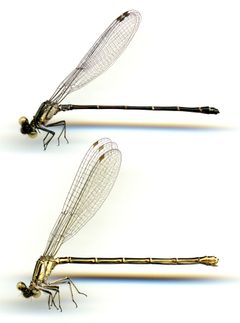
Argia translata, commonly known as the Dusky Dancer, is a in the Coenagrionidae. It is native to eastern and southern North America and has also been documented in parts of Central and South America. The species is relatively well-observed, with over 11,000 records on iNaturalist, suggesting it is not uncommon in suitable . As with other members of the Argia, it is associated with freshwater environments where it completes its aquatic larval development before emerging as a flying .
Pronunciation
How to pronounce Argia translata: /ˈɑr.dʒi.ə trænˈsleɪ.tə/
These audio files are automatically generated. While they are not always 100% accurate, they are a good starting point.
Identification
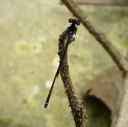
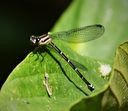
The Dusky Dancer can be distinguished from similar Argia by its generally dark, dusky coloration. Mature males typically exhibit dark thoracic patterning and may show pruinescence (a powdery blue-gray coating) on the . The species lacks the bright coloration seen in some such as the Blue-ringed Dancer (Argia sedula). Females are generally duller in coloration, often brownish or greenish, with less distinct patterning. The species is medium-sized within the , with a typical build: slender abdomen, widely separated , and wings held together above the body when at rest.
Images
Habitat
Freshwater streams and rivers with moderate flow. Associated with riparian vegetation where perch on emergent rocks and vegetation.
Distribution
Eastern and southern North America, extending from the United States through Mexico and into Central America. Records also exist from South America (Brazil: Amazonas, Pará, Roraima states).
Diet
are aerial capturing small flying insects. Larvae are aquatic predators feeding on small including mosquito larvae and other aquatic organisms.
Life Cycle
Hemimetabolous development with , larval (naiad), and stages. Eggs are laid in or near water. Larvae are aquatic and undergo multiple instars before emerging as winged adults. No free-living pupal stage occurs in Odonata.
Behavior
are active fliers that hunt by sight, seizing prey on the wing. When at rest, wings are held together above the body, characteristic of damselflies (Zygoptera). Males are territorial near water and use visual displays in mate recognition.
Ecological Role
at both larval and stages, contributing to regulation of insect in aquatic and terrestrial . Larvae serve as prey for fish and other aquatic predators; adults are prey for birds, , and other .
Human Relevance
Subject of citizen science observation efforts. Occasionally studied in freshwater biomonitoring programs due to sensitivity to water quality. No significant economic importance.
Similar Taxa
- Argia moestaPowdered Dancer shows extensive pale blue pruinoscence on mature males, unlike the darker, less A. translata
- Argia sedulaBlue-ringed Dancer has distinct blue ring markings on and brighter overall coloration
- Argia fumipennisVariable Dancer exhibits violet or blue coloration and different wing venation patterns
Sources and further reading
- BugGuide
- GBIF taxonomy match
- iNaturalist taxon
- NCBI Taxonomy
- Catalogue of Life
- Dragonfly Enthusiasts, Unite! Open House Set Nov. 6 at Bohart Museum | Bug Squad
- Bohart Museum Open House: Dragonflies Rule! | Bug Squad
- Bug Eric: New Mexico Dragonfly Blitz - Day 3
- Anura | Blog - Part 2
- Space4Nature: Satellites, AI... and Hand Lenses - Buglife Blog - Buglife
- How Three Entomologists Found Careers in Industry