
Calopteryx amata
Hagen, 1889
Superb Jewelwing
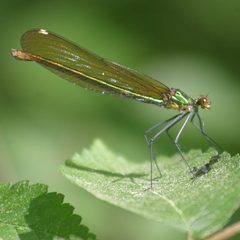
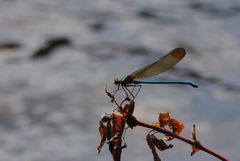
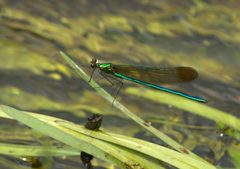
Calopteryx amata, commonly known as the superb jewelwing, is a in the Calopterygidae. Native to North America, it occurs in eastern Canada and the northeastern United States, with records extending south to Tennessee. As a member of the jewelwing group, it is characterized by the metallic wing coloration typical of the Calopteryx.
Pronunciation
How to pronounce Calopteryx amata: /kæˈlɒptərɪks əˈmɑːtə/
These audio files are automatically generated. While they are not always 100% accurate, they are a good starting point.
Identification
Distinguished from other Calopteryx by geographic range and specific wing characteristics. In the northeastern United States and adjacent Canada, it may occur with the related river jewelwing (Calopteryx aequabilis) and ebony jewelwing (Calopteryx maculata). Specific identification requires examination of wing venation, body proportions, and male clasping structures. The species name 'amata' (Latin for 'beloved') references its attractive appearance.
Images
Appearance
exhibit the characteristic metallic coloration of jewelwing . The body is slender with broad, often darkly pigmented or iridescent wings. Like other Calopteryx , males typically display more intense wing coloration than females. The wings are held together above the body when at rest, distinguishing damselflies from .
Habitat
Associated with forested streams and rivers, particularly in areas with moderate to fast current. Occupies riparian in both deciduous and mixed forest regions. Larvae are aquatic and require clean, well-oxygenated water.
Distribution
Eastern Canada and northeastern United States, ranging from Ontario, Quebec, and the Maritime provinces south through New England, New York, Pennsylvania, and into the Appalachian region as far south as Tennessee.
Seasonality
are active during the warmer months, typically from late spring through summer. Exact period varies with latitude, with northern active later into summer.
Life Cycle
Hemimetabolous development with aquatic larval stage. are laid in or near water on submerged vegetation. Larvae are aquatic , developing through multiple instars before emerging as winged . typically occurs in spring to early summer.
Ecological Role
function as aerial of small flying insects. Aquatic larvae are important predators in stream , feeding on various aquatic including mosquito larvae and other small organisms.
Human Relevance
Serves as an for healthy stream due to its sensitivity to water quality. Valued by naturalists and photographers for its striking appearance. No significant negative economic impact.
Similar Taxa
- Calopteryx aequabilis (River Jewelwing)Overlapping range in northeastern North America; distinguished by wing shape and male terminal appendage structure
- Calopteryx maculata (Ebony Jewelwing)Broadly sympatric in eastern North America; males have solid black wings rather than metallic or partially pigmented wings
More Details
Taxonomic history
Described by Hermann Hagen in 1889, a prominent 19th-century odonatologist.
Conservation status
Not currently considered threatened, though like many aquatic insects, vulnerable to stream degradation and loss.
Sources and further reading
- BugGuide
- GBIF taxonomy match
- iNaturalist taxon
- NCBI Taxonomy
- Catalogue of Life
- Dragonfly Enthusiasts, Unite! Open House Set Nov. 6 at Bohart Museum | Bug Squad
- Bohart Museum Open House: Dragonflies Rule! | Bug Squad
- Arctiidae | Beetles In The Bush
- Doubling down on defense: The polka-dot wasp moth, Syntomeida epilais — Bug of the Week
- Two beauties doubling down on defense: The polka-dot wasp moth, Syntomeida epilais, and spotted oleander caterpillar moth, Empyreuma pugione — Bug of the Week
- Monday Moth – Polka-dot Wasp Moth | Beetles In The Bush