
Plathemis subornata
Hagen, 1861
Desert Whitetail
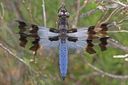
Plathemis subornata, commonly known as the Desert Whitetail, is a in the Libellulidae. It is native to arid regions of western North America, where it frequents ponds, streams, and other water bodies in desert and semi-desert . The species is often placed in the Libellula by some authorities. are active during warmer months and are frequently observed perching on rocks or vegetation near water.
Pronunciation
How to pronounce Plathemis subornata: /pləˈθimɪs sʌbɔːrˈneɪtə/
These audio files are automatically generated. While they are not always 100% accurate, they are a good starting point.
Identification
Plathemis subornata can be distinguished from similar Libellulidae by its predominantly white with black markings, particularly in mature males. The is pale with dark stripes. It resembles the Common Whitetail (Plathemis lydia) but occurs in more arid and has subtle differences in wing patterning and body proportions. Females and males have brownish abdomens with white spots rather than the continuous white band of mature males.
Images
Habitat
Arid and semi-arid regions including desert scrub, grasslands, and riparian corridors. Associated with permanent and temporary water bodies such as ponds, streams, springs, and cattle tanks in western North America.
Distribution
Western North America from the Great Basin and southwestern United States south through Mexico. Records from California, Nevada, Arizona, New Mexico, Utah, Colorado, Texas, and adjacent Mexican states.
Seasonality
active primarily from late spring through early fall (May–October), with peak activity during summer months. Activity patterns vary with elevation and local climate conditions.
Diet
are aerial capturing small flying insects. Larvae are aquatic predators feeding on aquatic and small vertebrates.
Life Cycle
Hemimetabolous development with , nymph (naiad), and stages. Eggs laid in or near water. Nymphs are aquatic and undergo multiple instars over one to two years before emerging as adults. typically occurs during warmer months.
Behavior
Males are territorial, perching on rocks or vegetation near water and making short to intercept intruders or pursue mates. Both sexes frequently perch with wings spread flat. are strong fliers capable of sustained hovering.
Ecological Role
function as aerial controlling of small flying insects. Nymphs serve as intermediate in aquatic . The contributes to nutrient cycling between aquatic and terrestrial through .
Human Relevance
Occasionally encountered by hikers and nature observers in desert regions. Not of direct economic importance. Serves as an for healthy aquatic in arid environments.
Similar Taxa
- Plathemis lydiaCommon Whitetail overlaps in range and shares similar white abdominal pattern in males, but prefers more mesic and has broader wing bands.
- Libellula pulchellaTwelve-spotted Skimmer has similar size and perching but is distinguished by dark wing spots and striped rather than white .