
Libellula luctuosa
Burmeister, 1839
Widow Skimmer
Libellula luctuosa, commonly known as the Widow Skimmer, is a in the Libellulidae. Males establish and defend territories at freshwater , engaging in aerial contests with intruding males. The species exhibits a resource-defense mating system where male reproductive success depends on territory quality. Females visit water primarily to mate and oviposit, typically during midday hours. Larvae are aquatic that undergo multiple before emerging as winged .
Pronunciation
How to pronounce Libellula luctuosa: /lɪˈbɛl.juː.lə lʊkˈtuː.ə/
These audio files are automatically generated. While they are not always 100% accurate, they are a good starting point.
Identification
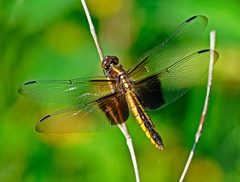
can be distinguished from similar Libellula by characteristic wing markings. Males and females show different coloration patterns, with males typically displaying more pronounced pruinescence. The species is one of the 'king skimmers' in the Libellula. Close examination of wing venation and abdominal patterning may be necessary to separate from such as Libellula lydia.
Images
Habitat
Freshwater water bodies including ponds, lakes, and slow-moving streams. Males establish territories at specific locations along shorelines suitable for oviposition. Larvae inhabit aquatic environments where they develop until .
Distribution
North America and Middle America. Recorded presence in the United States including Vermont. Temperate zone distribution with breeding in suitable freshwater .
Seasonality
Breeding season extends through summer months. Male at breeding sites increases linearly during mating seasons. Oviposition and hatching occur over approximately 3 months in summer. are active during daylight hours with peak female visitation at midday.
Life Cycle
with one per year. Larval are highly size-structured due to extended oviposition and hatching periods over summer. Larvae undergo multiple in water before emerging as . Fewer than 10% of larvae survive to emerge from the pond. Larval mortality is high in late summer and fall, negligible in winter, and high again in spring. Interodonate is a significant source of larval mortality.
Behavior
Males establish and defend territories at water bodies through aerial contests and physical combat. Two distinct male mating strategies exist: territorial males defend shoreline lengths, while satellite males perch and avoid male-male interactions. Satellite males increase later in the season when territories are fully occupied. Males practice non-contact mate guarding by flying above females during oviposition to prevent sperm competition. Females visit multiple males prior to mating. At low male , females are more likely to reject male mating attempts; at high density, females spend less time ovipositing immediately after mating. occurs among larvae and is an important dynamic.
Ecological Role
in both aquatic larval and terrestrial stages. Larvae are significant predators in freshwater , consuming other aquatic insects including mosquito larvae and conspecifics. Adults prey on flying insects captured in . Interodonate affects of co-occurring odonate .
Human Relevance
Used as a model organism for studies of behavioral , territoriality, and mating systems. Subject of research on effects of agricultural herbicides on aquatic insect , specifically atrazine exposure effects on cannibalistic responses. Presence indicates healthy freshwater .
Similar Taxa
- Libellula lydiaSimilar and ; both are pond-dwelling king skimmers with convergent use. Studies have directly compared their and mating systems.
- Libellula saturataCongeneric king skimmer with similar body plan and predatory , though differs in coloration and specific preferences.
More Details
Territorial Dynamics
Territory size decreases as increases. At high male , two males may simultaneously defend the same territory. form among co-occurring males, with males achieving higher mating success. Site attachment is low; males commonly move between territorial sectors and dominance status can change rapidly when changing sectors or returning to the pond.
Atrazine Sensitivity
Laboratory studies demonstrate that short-term exposure to atrazine herbicide at concentrations as low as 1 μg/L significantly alters cannibalistic in larvae, increasing time until stalking, striking, and consumption of prey.
Operational Sex Ratio Effects
As male increases during the breeding season without corresponding increases in fertilizable females, the operational sex ratio becomes increasingly male-biased. This intensifies male-male competition and alters female mate choice patterns, with precopulatory mate choice more common at low density and postcopulatory mate choice at high density.
Sources and further reading
- BugGuide
- GBIF taxonomy match
- iNaturalist taxon
- NCBI Taxonomy
- Catalogue of Life
- Know Your Dragonflies! | Bug Squad
- Just Buggin' Ya | Bug Squad
- Dragonfly Enthusiasts, Unite! Open House Set Nov. 6 at Bohart Museum | Bug Squad
- Bohart Museum Open House: Dragonflies Rule! | Bug Squad
- The Wonder of Dragonflies | Bug Squad
- Take a Bug Break--and Bring Along This Book | Bug Squad
- Comparative population ecology of the dragonflies Libellula lydia and Libellula luctuosa (Odonata: Libellulidae)
- The Behavioral Ecology of Libellula luctuosa (Burmeister) (Odonata: Libellulidae)
- The Evolution of Mating Systems in Temperate Zone Dragonflies (Odonata: Anisoptera) Ii: Libellula Luctuosa (Burmeister)
- Atrazine exposure increases time until cannibalistic response in the widow skimmer dragonfly (Libellula luctuosa)
- The Behavioral Ecology of Libellula luctuosa (Burmeister) (Anisoptera: Libellulidae): I. Temporal Changes in the Population Density and the Effects on Male Territorial Behavior