
Libellula forensis
Hagen, 1861
Eight-spotted Skimmer
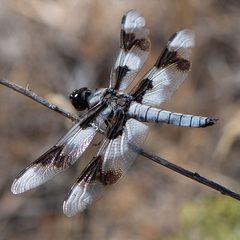
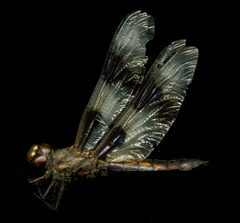
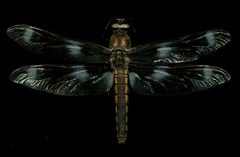
The eight-spotted skimmer (Libellula forensis) is a in the Libellulidae. It is a medium-sized skimmer native to western North America. Like other dragonflies in the Libellula, it is a predatory with aquatic larvae and aerial . The species is named for the distinctive pattern of spots on its wings.
Pronunciation
How to pronounce Libellula forensis: /lɪˈbɛl.ju.lə fɔˈrɛn.sɪs/
These audio files are automatically generated. While they are not always 100% accurate, they are a good starting point.
Identification
The eight-spotted skimmer can be distinguished from similar Libellula by the presence of eight distinct dark spots on the wings—two on each of the four wings. Males develop (whitish) with age. It differs from the twelve-spotted skimmer (Libellula pulchella) by having fewer wing spots, and from the widow skimmer (Libellula luctuosa) by wing pattern and abdominal coloration.
Images
Habitat
Associated with ponds, lakes, and slow-moving streams. Frequents open water with emergent vegetation for perching.
Distribution
Western North America, ranging from British Columbia through Washington, Oregon, and California, and eastward to the Rocky Mountain states.
Seasonality
are active from late spring through summer, with peak periods typically in June through August depending on latitude and elevation.
Diet
capture flying insects including bees, flies, and . Larvae are aquatic feeding on insect larvae, small crustaceans, and other aquatic .
Life Cycle
are laid in or near water. Aquatic nymphs (naiads) develop through multiple instars over one to two years before emerging as . Adults live for several weeks to a few months.
Behavior
are strong fliers that hunt from perches, sallying forth to capture prey. Males are territorial, defending mating territories near water. Both sexes perch conspicuously on vegetation or bare substrates.
Ecological Role
and nymphs function as in aquatic and terrestrial . Nymphs may influence prey in freshwater .
Human Relevance
Serves as a subject for ecological and behavioral research. Occasionally used as an for freshwater quality. Not known to be of agricultural or medical significance.
Similar Taxa
- Libellula pulchellaTwelve-spotted skimmer has twelve wing spots rather than eight; ranges overlap in some areas
- Libellula luctuosaWidow skimmer has different wing pattern with dark basal patches and white spots near wing tips; male becomes blue rather than white
More Details
Etymology
The specific epithet 'forensis' refers to the forum or marketplace, possibly alluding to the ' tendency to frequent open, exposed areas.
Sources and further reading
- BugGuide
- GBIF taxonomy match
- iNaturalist taxon
- NCBI Taxonomy
- Catalogue of Life
- Just Buggin' Ya | Bug Squad
- Dragonfly Enthusiasts, Unite! Open House Set Nov. 6 at Bohart Museum | Bug Squad
- Know Your Dragonflies! | Bug Squad
- Bohart Museum Open House: Dragonflies Rule! | Bug Squad
- The Wonder of Dragonflies | Bug Squad
- Take a Bug Break--and Bring Along This Book | Bug Squad