
Erythemis attala
(Selys in Sagra, 1857)
Black Pondhawk
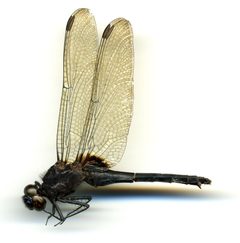
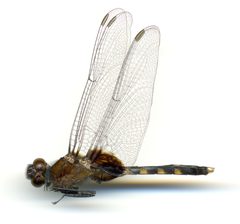
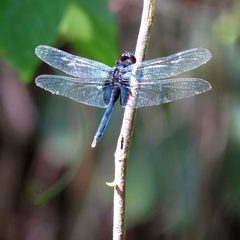
Erythemis attala, the black pondhawk, is a in the Libellulidae. It occurs across a broad geographic range spanning the Caribbean, Central America, North America, and South America. The species holds a least concern conservation status with stable . As a member of the Erythemis, it shares the pondhawk with related species such as the Eastern pondhawk (Erythemis simplicicollis).
Pronunciation
How to pronounce Erythemis attala: /ɛˈrɪθɛmɪs əˈtɑːlə/
These audio files are automatically generated. While they are not always 100% accurate, they are a good starting point.
Identification
The black pondhawk can be distinguished from the Eastern pondhawk (Erythemis simplicicollis) by geographic range and coloration; E. attala is predominantly black rather than green. It differs from the Western pondhawk (Erythemis collocata) in distribution, with E. attala occurring in the Caribbean and much of South America while E. collocata is restricted to western North America.
Images
Distribution
Found in the Caribbean Sea region, Central America, North America, and South America. Distribution records include numerous Brazilian states (Acre, Alagoas, Amazonas, Amapá, Bahia, Ceará, Distrito Federal, Espírito Santo, Goiás, Maranhão, Minas Gerais, Mato Grosso do Sul, Mato Grosso, Pará, Paraíba, Pernambuco, Piauí, Paraná, Rio de Janeiro, Rio Grande do Norte, Rondônia, Roraima, Rio Grande do Sul, Santa Catarina, Sergipe, São Paulo, Tocantins), as well as Colombia (Leticia, Villavicencio).
Similar Taxa
- Erythemis simplicicollisBoth share the pondhawk and similar body plan, but E. simplicicollis is primarily green and occurs in eastern North America, while E. attala is black and has a broader neotropical distribution.
- Erythemis collocataBoth are pondhawk with similar , but E. collocata is restricted to western North America and shows different geographic overlap with E. attala.
More Details
Conservation status
The IUCN lists Erythemis attala as Least Concern () with stable ; status reviewed in 2017.
Taxonomic history
Originally described by Selys in 1857, published in Sagra's work on Cuban natural history.