
Hylogomphus adelphus
(Selys, 1858)
Mustached Clubtail
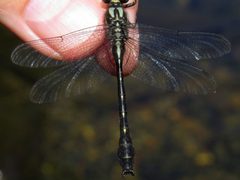
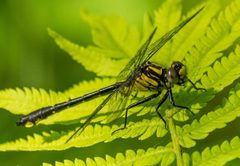
Hylogomphus adelphus, commonly known as the Mustached Clubtail, is a in the Gomphidae. It is a member of the clubtail group, characterized by expanded terminal abdominal segments. The species is native to eastern North America and is associated with riverine .
Pronunciation
How to pronounce Hylogomphus adelphus: /ˌhaɪ.loʊˈɡɒm.fəs əˈdɛl.fəs/
These audio files are automatically generated. While they are not always 100% accurate, they are a good starting point.
Identification
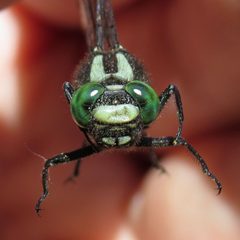
The "Mustached Clubtail" refers to dark facial markings that resemble a mustache, a diagnostic feature distinguishing this from other Hylogomphus. The clubbed tip of the , formed by expanded segments 7-9, is characteristic of the Gomphidae. Separation from such as Hylogomphus viridifrons requires examination of facial pattern and thoracic stripe configuration.
Images
Habitat
Flowing water including rivers and large streams with moderate to swift current. Larvae develop in sandy or rocky substrates.
Distribution
Eastern North America, with records from the northeastern United States including Vermont. The occurs in the Appalachian and adjacent regions.
Seasonality
are active from late spring through summer, with peak activity typically in June and July.
Ecological Role
are aerial capturing small flying insects. Larvae are aquatic predators in riverine .
Human Relevance
Subject of odonate observation and photography; contributes to regional biodiversity documentation.
Similar Taxa
- Hylogomphus viridifronsOverlaps in range and ; distinguished by facial pattern and thoracic stripe details.
- Other GomphidaeShare clubbed ; separated by facial markings and specific pattern elements.
More Details
Taxonomic Note
Hylogomphus was elevated from subgeneric status within Gomphus based on molecular and morphological evidence, reflecting distinct evolutionary lineages within North American clubtails.