
Gomphurus fraternus
(Say, 1840)
Midland Clubtail
Gomphurus fraternus, commonly known as the Midland Clubtail, is a in the Gomphidae. It is a medium-sized clubtail species found across eastern North America, with a distribution extending from the Great Lakes region through the northeastern United States. The species is recognized by its relatively slender with a modestly expanded club, greenish that meet at the top of the , and a pattern of yellow markings on a dark . are typically associated with medium to large rivers and streams.
Pronunciation
How to pronounce Gomphurus fraternus: //ˈɡɒm.fjʊr.əs frəˈtɜr.nəs//
These audio files are automatically generated. While they are not always 100% accurate, they are a good starting point.
Identification
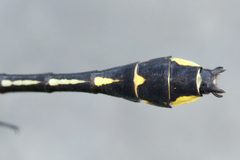
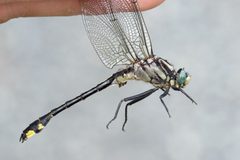
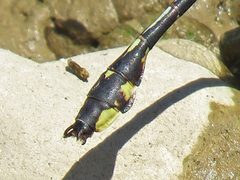
Distinguished from other Gomphurus by the combination of: green meeting broadly at the top of the (not separated); relatively slender club with yellow lateral spots on segment 9; and presence of a complete thoracic stripe. Most similar to Gomphurus lineatifrons (Splendid Clubtail), which has eyes more narrowly meeting or separated and more extensive yellow on the club. Differs from Gomphurus vastus (Cobra Clubtail) by smaller size, less dramatically expanded club, and different thoracic pattern. Separated from Gomphurus externus (Plains Clubtail) by eastern distribution and thoracic stripe pattern.
Images
Appearance
Medium-sized with total length 45–55 mm. green and broadly contiguous at the top of the . dark brown to black with yellow-green stripes, including a complete stripe and lateral stripes. dark with yellow markings on segments 1–7; segments 8–10 expanded into a modest club, with segment 9 showing yellow lateral spots. Wings clear with dark pterostigmata. Legs blackish with some pale markings.
Habitat
Medium to large rivers and streams with moderate to swift current, typically with rocky or gravelly substrates. patrol over open water or perch on rocks, logs, or vegetation along shorelines. Larvae develop in similar riverine , burrowing in sandy or muddy substrates.
Distribution
Eastern North America, from Ontario and the Great Lakes region east to New England and south through the Appalachian region to northern Georgia and Alabama. Core range includes the Ohio River basin, upper Mississippi River drainage, and Atlantic coastal drainages.
Seasonality
active from late May through August, with peak in June and July in most of the range. period varies with latitude, occurring earlier in southern portions and later in northern areas.
Life Cycle
Hemimetabolous development with , nymph (naiad), and stages. Eggs laid in or near water, likely in vegetation or directly into water. Nymphal stage lasts approximately 2–3 years in temperate climates. Nymphs are burrowers in river substrates, waiting in ambush for prey. typically occurs at night on exposed rocks or vegetation along shorelines.
Behavior
are strong fliers that patrol territories over water, frequently perching on rocks or bare ground near the water's edge. Males defend territories along river shorelines. Both sexes may be found some distance from water in meadow or woodland when not actively breeding. Adults are wary and can be difficult to approach.
Ecological Role
Predatory nymphs and contribute to aquatic and riparian . Nymphs serve as prey for fish and other aquatic . Adults prey on small flying insects. The serves as an indicator of relatively unimpacted riverine with good water quality.
Human Relevance
Subject of interest to odonatologists and nature observers. Not known to be of economic importance. Presence used in biomonitoring of river health. reflects its central distribution relative to other clubtail .
Similar Taxa
- Gomphurus lineatifronsOverlaps in range and appearance; distinguished by more narrowly meeting or separated and more extensive yellow on abdominal club.
- Gomphurus vastusLarger size with more dramatically expanded club and different thoracic pattern; often found in similar .
- Gomphurus externusWestern counterpart ; distinguished by distribution and subtle differences in thoracic stripe pattern.
More Details
Taxonomic History
Originally described as Gomphus fraternus by Thomas Say in 1840. Transferred to Gomphurus following molecular and morphological studies that split the former broadly defined Gomphus into multiple genera.