
Gomphurus externus
(Hagen in Selys, 1858)
Plains Clubtail
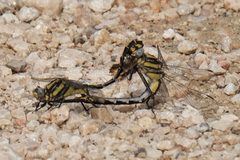
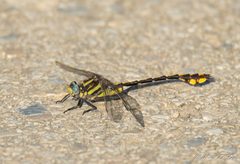
Gomphurus externus, commonly known as the plains clubtail, is a medium to large in the clubtail Gomphidae. range 52–60 mm in length and are distinguished by yellow facial markings, striped , and a clubbed tip. The inhabits rivers and large streams across central North America, with peak activity in mid-summer. Nymphs are burrowers in muddy substrates and exhibit unusual daytime .
Pronunciation
How to pronounce Gomphurus externus: //ˈɡɒm.fjʊ.rəs ɛkˈstɜːr.nəs//
These audio files are automatically generated. While they are not always 100% accurate, they are a good starting point.
Identification
distinguished from similar clubtails by combination of: yellow , parallel yellow thoracic stripes (not wider brown stripes), and specific abdominal patterning. Most similar to Tamaulipan clubtail (larger, darker, wider brown thoracic stripes, females lack erect yellow spines on postocellar ridge) and pronghorn clubtail (smaller, male with barely wider than ). Sulphur-tipped clubtail differs in smaller size, yellow , and more yellow on club. Nymphs identified by single rear-facing spine on each side of segments 6–9, absence of hooks, and thick tapering to rounded point.
Images
Habitat
Moderately flowing rivers and large streams with muddy bottoms; occasionally lakes. Nymphs occupy specific stretches within river systems, burrowing into sand or mud substrates.
Distribution
North America: United States (Arkansas, Colorado, Iowa, Idaho, Illinois, Indiana, Kansas, Kentucky, Maine, Michigan, Minnesota, Missouri, Montana, Nebraska, North Dakota, New Mexico, Ohio, South Dakota, Texas, Utah, Wisconsin, Wyoming, U.S. Virgin Islands) and Canada (Manitoba).
Seasonality
Multiple periods reported. Most common: mid-July to mid-August. Additional period: early April to mid-August. Most abundant in spring. Wisconsin records: early June to mid-July. rarely active on cool or cloudy days.
Diet
: soft-bodied flying insects including mosquitoes, flies, butterflies, , mayflies, flying ants, , and other . Nymphs: aquatic insects including mosquito larvae, aquatic fly larvae, larvae; also freshwater shrimp, small fish, and tadpoles.
Life Cycle
stage: females lay over 5000 eggs by dipping tip into water while hovering. Nymph stage: aquatic, burrowing in mud/sand with abdomen tip exposed for respiration. : (unusual for ). stage: terrestrial/aerial.
Behavior
Nymphs burrow into substrates, leaving upturned abdominal tip exposed to pump water for respiration. perch on rocks or bare sand with elevated and wings drooping to touch ground. Hunt from these perches. Cannot tolerate cool temperatures; activity ceases on cool or cloudy days. Mating followed by solitary -laying by females.
Ecological Role
in both aquatic (nymph) and terrestrial () . Nymphs contribute to benthic regulation. Adults serve as aerial . Sensitive to temperature conditions, potentially indicating thermal quality.
Human Relevance
No significant negative interactions. considered widespread, abundant, and secure. May serve as for riverine quality due to specific microhabitat requirements.
Similar Taxa
- Tamaulipan clubtailLarger and darker; wider brown thoracic stripes; females lack erect yellow spines at ends of postocellar ridge
- Pronghorn clubtailSmaller; male barely wider than ; may not always be reliably separated
- Sulphur-tipped clubtailSmaller; yellow on ; more yellow on club
More Details
Nymph emergence
Unlike most , nymphs emerge as during daytime rather than at dawn or dusk.
Habitat selectivity
Nymphs exhibit strong microhabitat specificity, often occurring only in particular stretches of individual rivers or streams.
Fecundity
Laboratory experiments documented females capable of laying over 5000 .