
Epitheca semiaquea
(Burmeister, 1839)
Mantled Baskettail
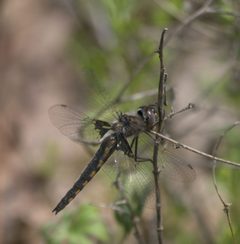
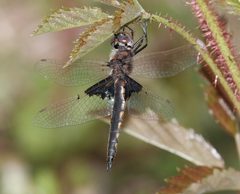
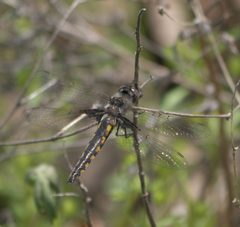
Epitheca semiaquea, the mantled baskettail, is a of emerald in the Corduliidae. It occurs in North America and is listed as Least Concern by the IUCN with a stable . Like other baskettails, females exhibit a distinctive oviposition in which are extruded into a gelatinous mass and deposited by dragging the through water during .
Pronunciation
How to pronounce Epitheca semiaquea: /ˌɛpɪˈθiːkə ˌsɛmiˈækwɪə/
These audio files are automatically generated. While they are not always 100% accurate, they are a good starting point.
Identification
Baskettails may be confused with Libellulidae skimmers at first glance. Key distinguishing features include longer, narrower and brilliant green in . -level identification within Epitheca requires examination of specific wing patterns and abdominal markings; E. semiaquea is distinguished from congenerics by subtle differences in wing maculation and abdominal patterning, though precise diagnostic characters are not detailed in available sources.
Images
Appearance
have brilliant green , a characteristic of emerald dragonflies in Corduliidae. The body is relatively non-descript and can be mistaken for skimmer (Libellulidae), though the is longer and narrower than typical skimmers. Specific coloration and pattern details for E. semiaquea are not documented in available sources.
Habitat
Associated with aquatic environments including lakes and wetlands. Observations have been made near bodies of water with adjacent forested and prairie vegetation.
Distribution
North America. Specific range boundaries within the continent are not detailed in available sources.
Seasonality
are active in spring and early summer, consistent with the general pattern for baskettails.
Life Cycle
Oviposition occurs via exophytic deposition: females extrude into a gelatinous mass held by the subgenital plate, then fly low over water dragging the to release a trailing rope of eggs several feet long. Eggs are deposited among tangles of floating and emergent vegetation. Prior to deposition, females may be observed with rhythmic abdominal movements while perched. Other life stages and developmental details are not documented in available sources.
Behavior
Females exhibit distinctive pre-oviposition involving slow, rhythmic back-and-forth movement of the while perched vertically, during which the mass gradually becomes visible. During oviposition , the abdomen tip is held aloft in a characteristic posture. Females may remain motionless and tolerant of close approach during the pre-oviposition phase.
Ecological Role
as . and aquatic nymphs (details undocumented) likely function as prey for aquatic predators. Specific roles are not documented in available sources.
Human Relevance
Subject of nature observation and photography. IUCN status Least Concern (reviewed 2017) indicates no immediate conservation concern or significant human impact documented.
Similar Taxa
- Epitheca princepsCongeneric Prince Baskettail shares characteristics and similar body plan; differs in timing (active later in summer) and specific wing patterning
- Libellula pulchellaTwelve-spotted Skimmer resembles baskettails in general appearance but has broader and lacks brilliant green of Corduliidae
More Details
Etymology note
The 'baskettail' derives from the female's -laden subgenital plate that resembles a basket, and the habit of holding the tip aloft like a raised tail during .