
Sisyra nigra
(Retzius, 1783)
Black Spongillafly, Black Spongefly
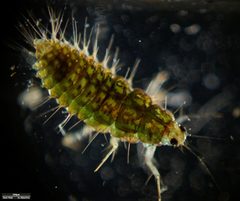
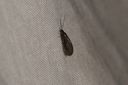
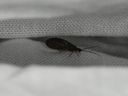
Sisyra nigra is a small in the Sisyridae, commonly known as the Black . It is the most widely distributed of the three British Sisyridae and occurs across the Holarctic region. The species has a unique with fully aquatic larvae that are specialized of freshwater sponges, while are terrestrial and dispersive. S. nigra is notable for its distinctive achiasmatic segregation mechanism during male , which differs from other Neuroptera and supports the basal phylogenetic position of Sisyridae within the order.
Pronunciation
How to pronounce Sisyra nigra: //ˈsɪsɪrə ˈnɪɡrə//
These audio files are automatically generated. While they are not always 100% accurate, they are a good starting point.
Images
Habitat
Lakes, ponds, and slow-moving rivers. disperse from water bodies and can be encountered on overcast, humid nights at some distance from aquatic .
Distribution
Holarctic; found in Europe and Northern Asia (excluding China) and North America. Common and widespread throughout Finland; most widely distributed of the three British Sisyridae .
Diet
Host Associations
- Ephydatia - larval food sourcefreshwater sponge
- Spongilla - larval food sourcefreshwater sponge
Life Cycle
are laid on branches overhanging water. Larvae are fully aquatic: initially free-swimming, then feeding within sponge tissue. occurs on land. disperse from water bodies after .
Behavior
Larvae possess numerous morphological and physiological adaptations to their specialized aquatic . rest in typical fashion with wings held in a tent-like shape over the body. Can be attracted to light traps on overcast, humid nights.
Ecological Role
Sources and further reading
- BugGuide
- Wikipedia
- GBIF taxonomy match
- iNaturalist taxon
- NCBI Taxonomy
- Catalogue of Life
- Sanctuary for the Betulaceae | Beetles In The Bush
- Stories about small insects and making a big difference - Buglife Blog - Buglife
- An Achiasmatic Mechanism That Ensures the Regular Segregation of Sex Chromosomes in Male Meiosis in the Black Spongilla-Fly <em>Sisyra nigra</em> (Retzius 1738), Sisyridae, Differs from the Mechanism Commonly Observed Within Neuroptera
- An Achiasmatic Mechanism That Ensures the Regular Segregation of Sex Chromosomes in Male Meiosis in the Black Spongilla-fly Sisyra nigra (Retzius 1738), Sisyridae, Differs from the Mechanism Commonly Observed Within Neuroptera
- The genome sequence of the Black Spongefly, Sisyra nigra (Retzius, 1783).