
Yersiniops sophronicus
(Rehn & Hebard, 1908)
Yersin's ground mantis
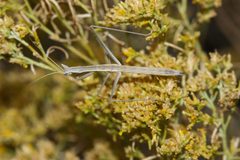
Yersiniops sophronicus, commonly known as Yersin's ground mantis, is a small ground-dwelling native to North America. Unlike typical ambush mantids that perch on vegetation, this has adopted a hunting strategy, actively running down prey in open . It belongs to a small group of ground mantids in the Yersiniops and Litaneutria that are specialized for life in arid and semi-arid environments. The species is distinguished from its Litaneutria by pointed upper margins that create a 'horned' facial appearance.
Pronunciation
How to pronounce Yersiniops sophronicus: /jɛrˌsɪniˈɒps səˈfrɒnɪkəs/
These audio files are automatically generated. While they are not always 100% accurate, they are a good starting point.
Identification
Distinguished from the co-occurring Litaneutria by the pointed upper margins of the , which give a 'horned' appearance (Litaneutria has rounded eyes). Yersiniops also tend toward gray coloration, while Litaneutria tends toward brown. The -on view is particularly diagnostic for separating these two genera of ground mantids.
Images
Appearance
Small with cryptic gray coloration. The upper margins of the are pointed, creating a distinctive 'horned' appearance when viewed -on—this contrasts with the rounded eyes of the related Litaneutria. Overall body form is compact and adapted for locomotion. Wing development varies: may possess small wings, with females typically brachypterous (short-winged).
Habitat
Desert and grassland across western North America. Occupies open, xeric environments with sparse vegetation where hunting strategies are advantageous.
Distribution
Native to North America. Records indicate presence in western United States, particularly in arid and semi-arid regions.
Behavior
that actively runs down prey rather than employing the ambush strategy typical of most mantids. Has been observed hopping over rocks and darting swiftly through sparse vegetation when pursuing prey or evading predators.
Ecological Role
in arid grassland and desert . Represents an alternative hunting strategy within the Mantodea, filling a predatory in open where vegetation-based ambush is less effective.
Human Relevance
Of interest to entomologists and collectors due to its distinctive ground-dwelling habits and 'horned' facial appearance. The -on view is considered photogenic.
Similar Taxa
- Litaneutria minorCo-occurs in western North American grasslands and deserts; distinguished by rounded (not pointed) margins and tendency toward brown rather than gray coloration.
- Litaneutria obscuraRestricted to desert southwest; also has rounded and brown coloration, differing from Yersiniops in eye shape and color tone.
More Details
Cursorial strategy evolution
The (running) hunting strategy has evolved independently at least three times in Mantodea, always associated with dry/xeric with limited non-herbaceous vegetation. The transition from woodlands to grasslands appears to have been a key driver selecting for this active hunting mode.
Taxonomic note
The Yersiniops and Litaneutria represent the ground fauna of the United States, both placed in tribe Litaneutriini within Amelidae.