
Ypsolopha unicipunctella
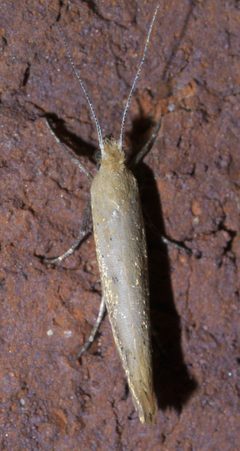
Ypsolopha unicipunctella is a small in the Ypsolophidae, recorded from the southwestern United States. The is characterized by a single conspicuous black dot on the forewing, which gives rise to its specific epithet. rest in a distinctive posture with the body inverted and extended forward. The species is poorly known biologically, with limited records despite its relatively broad geographic range.
Pronunciation
How to pronounce Ypsolopha unicipunctella: /ɪpˈsoʊləfə ˌjuːnɪsɪpʌŋkˈtɛlə/
These audio files are automatically generated. While they are not always 100% accurate, they are a good starting point.
Identification
The single prominent black dot on the forewing distinguishes Y. unicipunctella from with multiple spots or different marking patterns. The pale olive buff ground color with golden reflections separates it from darker or differently colored Ypsolopha . The silvery gray hindwings contrast with the forewing coloration. Antennal and palpal coloration (white with dark dots, fuscous with white striations) provide additional diagnostic characters when specimens are examined closely.
Images
Appearance
Wingspan 17–23 mm. Forewings unicolored pale olive buff with golden reflections, bearing one conspicuous black round dot at the end of the plus scattered black scales in the region. Hindwings light silvery gray, darkening toward the margins. white with dark brown dots. Labial palpi dark fuscous on the outside, transversely striated with white; underside and inside of second joint silvery white. Terminal joint of palpi thickened anteriorly with rough ; brush small. , , and concolorous with forewings.
Distribution
United States: Oklahoma, Texas, and Arizona. The occupies a southwestern North American range with records from three states.
Behavior
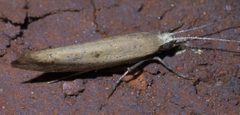
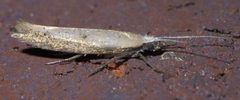
rest in an inverted posture with stretched forward, a characteristic of the Ypsolopha. Adults are rarely attracted to light, making collection difficult.
Similar Taxa
- Other Ypsolopha speciesMany share similar size and general appearance, but differ in forewing pattern (multiple dots, streaks, or different ground coloration)
More Details
Collection difficulty
Ypsolophid are notoriously difficult to collect using standard methods. of many fly to light infrequently, and larvae are solitary and hard to locate on plants. This contributes to the scarcity of specimens and biological information for Y. unicipunctella.