
Argyresthia pygmaeella
(Denis & Schiffermüller, 1775)
Sallow Argent
A small microlepidopteran in the Argyresthiidae, first described from Vienna, Austria in 1775. are active from May to August with a single . The is associated with willows, where larvae mine leaf-buds and shoots. It has a broad distribution across Europe, northern Asia, and North America.
Pronunciation
How to pronounce Argyresthia pygmaeella: //ˌɑːr.dʒɪˈrɛs.θi.ə ˌpɪɡ.miˈɛl.ə//
These audio files are automatically generated. While they are not always 100% accurate, they are a good starting point.
Identification
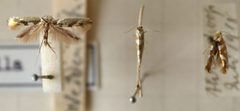
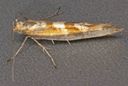
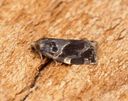
Small white with distinctive golden or brown transverse forewing markings. Distinguished from other Argyresthia by specific pattern of golden markings: spot at 1/3 with connecting streak to base, oblique streak from dorsum, and tornal spot. Hindwings grey (not white). Very small size (3.2–6.8 mm body length per Eric observation of ) requires close examination or genitalia dissection for definitive identification.
Images
Appearance
Wingspan 11–14 mm. Forewings white with golden or brown markings, including a spot at 1/3 connected to base by a streak along the fold, an outwardly oblique streak from middle of dorsum, and a tornal spot. Hindwings grey. and ochreous-whitish, with golden . Legs and white.
Habitat
Associated with willow stands. In North America, primarily in mountainous areas but also present in prairies with plants. European occur in willow-dominated .
Distribution
Europe, northern Asia, and North America. Specific records include Austria (type locality near Vienna), Belgium, and New Mexico (USA).
Seasonality
Single annually. fly from May to August, with timing varying by location. Larvae overwinter in leaf-buds, becoming active in April and reaching full growth in May or June.
Diet
Larvae feed on willows (Salix spp.), specifically recorded from goat willow (Salix caprea) and grey willow (Salix cinerea). Larvae mine in leaf-buds, bore into shoots causing drooping, and may feed on catkins.
Host Associations
- Salix caprea - larval plantgoat willow
- Salix cinerea - larval plantgrey willow
Life Cycle
laid on willows. Larvae overwinter in leaf-buds, emerge in April to bore into shoots. Full-grown larvae in May or June, 11 mm long, green body with dark-brown to black , prothoracic and anal shields. occurs in feeding place or on ground in May or June. emerge May–August.
Behavior
Larvae cause characteristic drooping of willow shoots by boring into them. Shoot-mining distinguishes this from conifer-mining relatives in the .
Ecological Role
Herbivore of willows; shoot-boring larvae may influence willow growth form. Serves as prey for .
Human Relevance
Minor significance as a willow pest; shoot damage may affect ornamental or managed willow plantings. No major economic impact documented.
Similar Taxa
- Other Argyresthia speciesMany congeneric are white with metallic markings; A. pygmaeella distinguished by willow association and specific golden marking pattern on forewing
- Yponomeuta spp.Similar (historically placed together), but generally larger with different wing patterns and associations
More Details
Family placement note
Historically placed in Yponomeutidae; now classified in Argyresthiidae per modern