
Argyresthia austerella
Zeller, 1873
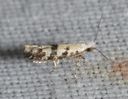
Argyresthia austerella is a micro- in the Argyresthiidae, first described by Zeller in 1873. It is native to North America with a documented range spanning from Florida to New Hampshire and westward to Texas and Missouri. The species is characterized by its small size (wingspan 8–9 mm) and distinctive wing pattern featuring dark brown markings on a white ground color. Like other members of its , it is presumed to have larvae that mine conifer needles or broadleaved plants, though specific associations for this species remain undocumented.
Pronunciation
How to pronounce Argyresthia austerella: /ˌɑːrdʒɪˈrɛsθiə ˌɔːstəˈrɛlə/
These audio files are automatically generated. While they are not always 100% accurate, they are a good starting point.
Identification
Distinguished from other Argyresthia by the specific arrangement of three parallel dark streaks on white forewings: an oblique streak before the middle of the , a broader parallel fascia beyond the middle, and a third diffused streak at the third. The mottled dark brown costal and apical areas with white dots and dashes are distinctive. Accurate identification to species level in this often requires examination of genitalia characters due to the similarity of wing patterns among .
Images
Habitat
Specific preferences are not documented. Based on documented distribution, the occurs in diverse eastern and central North American environments ranging from subtropical (Florida) to temperate (New Hampshire, Illinois) conditions. Related Argyresthia species are associated with coniferous and mixed forests where larval plants occur.
Distribution
North America: documented from Florida, Texas, Oklahoma, Ohio, Kentucky, Illinois, Missouri, New Hampshire, and Maryland. The range spans the eastern and central United States.
Similar Taxa
- Other Argyresthia speciesMany share the -characteristic pattern of white wings with dark transverse or oblique markings. Accurate separation requires detailed examination of streak placement, width, and genitalia .
- Argyresthia (genus)The broader shares the micro- size (3.2–6.8 mm body length), white ground coloration with metallic or dark stripes, and conifer/broadleaf mining larval habits, but A. austerella is distinguished by its specific three-streak pattern.
More Details
Family Classification Note
Argyresthiidae is treated as a distinct in modern classifications (GBIF, NCBI), though some sources (e.g., Catalogue of Life) place it within the superfamily Yponomeutoidea. Earlier sources sometimes classified Argyresthia within Yponomeutidae.
Identification Caution
The source notes that many Argyresthia can only be determined by dissecting genitalia, and that identifications based on external characters alone should be regarded as tenuous.