
Anopina ednana
(Kearfott, 1907)
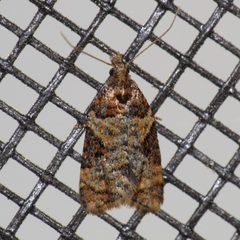
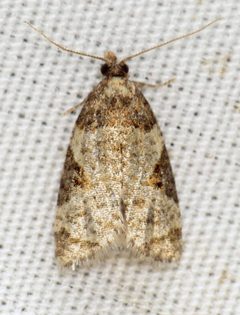
Anopina ednana is a small tortricid of eastern North America, described by Kearfott in 1907 from specimens collected in the northeastern United States and adjacent Canada. The is distinguished by its diminutive size, with a wingspan of only 11–12 mm. Its specific epithet honors Edna L. Beutenmüller, a scientific illustrator who contributed significantly to early American entomology. The species appears to be genuinely uncommon, with fewer than 100 verifiable observations documented despite more than a century since its description.
Pronunciation
How to pronounce Anopina ednana: /əˈnoʊpɪnə ɛdˈnænə/
These audio files are automatically generated. While they are not always 100% accurate, they are a good starting point.
Identification
The extremely small size (11–12 mm wingspan) distinguishes A. ednana from most North American tortricids, though several Anopina overlap in this range. Positive identification requires examination of genitalic ; external characters alone are insufficient to separate it from . Dissection and comparison with type material or authoritative illustrations is necessary for certain determination.
Images
Appearance
A minute tortricid with wingspan 11–12 mm. Specific wing pattern details have not been formally described in accessible literature. As a member of Cochylini, likely possesses relatively broad, somewhat triangular forewings typical of the tribe, but definitive diagnostic characters for this remain undocumented in sources other than original type description.
Distribution
Eastern North America: documented from Maine, Massachusetts, New Hampshire, Vermont, Pennsylvania, West Virginia, North Carolina, Tennessee in the United States; Ontario, Quebec, Alberta, and Saskatchewan in Canada. The western Canadian records (Alberta, Saskatchewan) extend the known range considerably beyond the core eastern distribution and may represent disjunct or vagrant individuals.
Human Relevance
Named in honor of Edna L. Beutenmüller (1872–1934), scientific illustrator at the American Museum of Natural History who prepared numerous plates for early entomological publications. No economic or conservation significance has been documented.
Similar Taxa
More Details
Etymology
Named for Edna L. Beutenmüller, scientific illustrator and wife of entomologist William Beutenmüller. The specific epithet 'ednana' is a Latinized form of her first name, a rare example of patronymic honoring a woman in early 20th century lepidopteran .
Taxonomic History
Originally described as Tortrix ednana by Kearfott in 1907, subsequently transferred to Anopina. The original description appeared in the Proceedings of the United States National Museum.