
Archips rosana
(Linnaeus, 1758)
Rose Tortrix, Rose Tortrix Moth, Rose Leaf Roller
Archips rosana, the rose tortrix , is a leafroller moth in the Tortricidae distributed across the Palearctic and Nearctic realms. The is a significant agricultural pest of apple orchards and other fruit crops, with larvae feeding within rolled leaves. are active from May to August, with specific timing varying by location. The species is subject to substantial by , with parasitisation rates reaching 24-40% in some .
Pronunciation
How to pronounce Archips rosana: //ˈɑːrkɪps roʊˈsɑːnə//
These audio files are automatically generated. While they are not always 100% accurate, they are a good starting point.
Identification
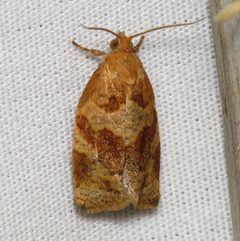
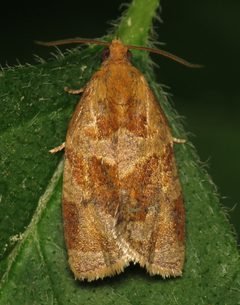
Distinguished from similar tortricid leafrollers by the combination of sinuate forewing termen, irregular costal fold extending beyond the middle of the wing, and orange-tinged hindwing apex. The larva is identified by its dark olive-green coloration with white tubercular spots and characteristic blackish plate on segment 2 with whitish margin. may be separated from Archips purpurana and other congeneric by forewing pattern details, though genitalia examination may be required for definitive identification.
Images
Appearance
Wingspan 15–24 mm. Forewings with sinuate, vertical termen; costal fold from base to beyond middle, irregular and light brown, sometimes reddish-tinged, darker and strigulated in female. spot near base present. edge of central fascia sinuate. Suffused costal patch emits interrupted darker brown, sometimes nearly obsolete in female. Dark terminal strigulae present. Hindwings grey, apex usually more or less orange. Larva dark olive-green with darker dorsal line; tubercular spots white; brown; plate of segment 2 blackish, anteriorly whitish.
Habitat
Apple orchards; fruit-bearing shrubs; areas with Rosaceae including cultivated rose and raspberry. Found in both managed agricultural settings and natural such as the Ile-Alatau State National Natural Park in Kazakhstan where wild apple (Malus sieversii) occurs.
Distribution
Palearctic and Nearctic realms. Recorded from: Western Europe (Belgium), Western Turkey (Denizli and Usak provinces), Poland (Wielkopolska region), Kazakhstan (Iley Alatau), and Iran. Widespread in apple-growing regions worldwide.
Seasonality
on wing from May to August, with exact timing depending on location. First adults captured in late May in Western Turkey (May 24 in Civril, Denizli; May 30 in Sivasli, Usak in 2019). Larvae of 1-2 instars appear from second decade of April to first decade of May in Kazakhstan. occurs from April to May. overwinters as .
Diet
Larvae feed within rolled leaves on Rosaceae including apple (Malus domestica, Malus sieversii), raspberry (Rubus), and cultivated rose (Rosa). Mass feeding occurs on leaf rosettes, developing leaves, buds, flowers, and fruit buds in orchards.
Host Associations
- Malus domestica - larval primary agricultural
- Malus sieversii - larval wild apple in Kazakhstan
- Rubus - larval raspberry
- Rosa - larval cultivated rose, source of
Life Cycle
Overwinters as . Larvae develop through multiple instars, with 1-2 instars appearing from mid-April to early May in Kazakhstan. occurs from April to May. emerge and are active May to August. Complete development details for all instars not fully documented in available sources.
Behavior
Larvae construct silk-bound rolled leaves as feeding shelters. When threatened, larvae exhibit 'ejection' —rapidly exiting the leaf roll and descending on a silken line, then climbing back once danger passes. This behavior is exploited by hunting such as Ancistrocerus unifasciatus, which use abdominal vibrations to stimulate ejection and capture. captured using traps for monitoring purposes.
Ecological Role
Agricultural pest causing serious crop losses in apple orchards. for diverse complex including in Braconidae, Chalcididae, Ichneumonidae, Eulophidae, Pteromalidae, and Tachinidae. Parasitoids provide significant , with Ichneumonidae most effective. Key parasitoid species include Phytodietus astutus, Itoplectis maculator, Scambus inanis, and Cotesia glomerata.
Human Relevance
Significant economic pest of apple production worldwide. Subject to programs utilizing conservation and monitoring. potential through parasitoid . Misidentification of this in faunistic records has occurred, highlighting need for professional identification in pest management contexts.
Similar Taxa
- Archips purpuranaSimilar leafroller and ; both use goldenrod and other ; distinguished by forewing pattern details and genitalia
- Archips crataeganaCongeneric leafroller with similar ; distinguished by specific wing pattern characteristics and associations
- Other Archips speciesMany congeneric tortricids share leaf-rolling larval habit and general appearance; definitive identification often requires genitalia examination
Sources and further reading
- BugGuide
- Wikipedia
- GBIF taxonomy match
- iNaturalist taxon
- NCBI Taxonomy
- Catalogue of Life
- Bug Eric: How to Catch a Leafroller Caterpillar (Video)
- Pensoft Editorial Team | Blog - Part 69
- Population dynamics and parasitoid complex of Archips rosana (L.) (Lepidoptera: Tortricidae) in Western Turkey
- Rose leaf roller Archips rosana L. as a pest of Sievers apple tree in Iley Alatau
- Controlling the abundance of the rose tortrix moth [Archips rosana (L.)] by parasitoids in apple orchards in Wielkopolska, Poland
- The parasitisation of the rose tortrix [Archips rosana (L.)] Population in the apple orchard in the Wielkopolska region, Poland
- New Record and DNA Barcoding of Dolichogenidea laevigata (Ratzeburg, 1848) as a Parasitoid of Archips rosana (Linnaeus, 1758) from Iran