
Pseudosciaphila duplex
(Walsingham, 1895)
Poplar Leafroller Moth, Aspen Leaftier, Spotted Aspen Leafroller
Pseudosciaphila duplex is a tortricid native to North America, commonly known as the poplar leafroller moth or aspen leaftier. are active during summer months and possess a wingspan of 20–25 mm. The is notable for its larval association with deciduous trees in the Populus, Betula, and Salix, where larvae feed on leaves.


Pronunciation
How to pronounce Pseudosciaphila duplex: /sjuːdoʊsaɪəˈfɪlə ˈdjuːplɛks/
These audio files are automatically generated. While they are not always 100% accurate, they are a good starting point.
Identification
Distinguished from similar tortricid moths by the specific wing pattern referenced in its specific epithet 'duplex,' indicating a double or paired marking. The combination of small size (20–25 mm wingspan), mottled forewings with darker markings, and association with Populus, Betula, or Salix plants aids identification. Larval leaf-rolling on these hosts is also diagnostic.
Images
Appearance
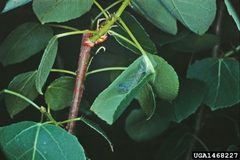
have a wingspan of 20–25 mm. The forewings display a mottled pattern with darker markings, typical of many olethreutine tortricids. The specific epithet 'duplex' refers to a double or paired marking pattern visible on the wings. Larvae are leaf-rolling caterpillars that construct shelters by tying leaves together with silk.
Habitat
Associated with deciduous forests and woodlands containing trees in the Populus (poplars, aspens), Betula (birches), and Salix (willows). Occurs in riparian corridors, forest edges, and open woodlands across its range.
Distribution
North America, from Quebec and New England westward to northern California and British Columbia. Records exist from Canadian provinces including Alberta, Manitoba, and Saskatchewan, and from Vermont in the United States.
Seasonality
are on wing from June to August. Larval activity presumably occurs earlier in the growing season, coinciding with leaf development of trees.
Diet
Larvae feed on leaves of Populus (poplar/aspen), Betula (birch), and Salix (willow) . do not feed.
Host Associations
- Populus - larval food plantaspen, poplar
- Betula - larval food plantbirch
- Salix - larval food plantwillow
Life Cycle
Complete with , larval, pupal, and stages. Larvae are leaf-rollers that construct shelters by tying leaves together with silk, feeding on the enclosed foliage. presumably occurs within the larval shelter or in leaf litter. Adults emerge in summer.
Behavior
Larvae exhibit leaf-rolling , constructing silk-tied leaf shelters for feeding and protection. are and attracted to light.
Ecological Role
Herbivore in deciduous forest ; larval feeding on leaves of Populus, Betula, and Salix contributes to nutrient cycling and may influence plant . Serves as prey for various including birds, , and predatory insects.
Human Relevance
Minor economic significance as a defoliator of ornamental and timber trees in the Populus, Betula, and Salix. Not considered a major pest. Of interest to lepidopterists and naturalists.
Similar Taxa
- Other Pseudosciaphila speciesCongeneric may share similar size, wing pattern, and associations; precise identification requires examination of genitalia or molecular markers
- Other Olethreutini leafrollersMany tortricid moths in the tribe Olethreutini exhibit similar leaf-rolling larval and association with deciduous trees; wing pattern and specificity distinguish P. duplex
More Details
Taxonomic History
Described by Walsingham in 1895. The specific epithet 'duplex' refers to the double or paired wing markings characteristic of this .
Collection Records
Over 1,700 observations recorded on iNaturalist, indicating it is relatively well-documented and not rare within its range.