
Rhopobota naevana
(Hübner, 1817)
holly tortrix moth, holly leaf tier, blackheaded fireworm
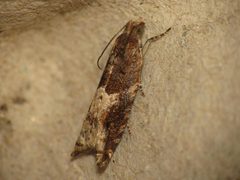
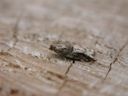
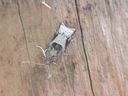
Rhopobota naevana is a small tortricid with a broad Palearctic distribution extending to North America. fly in mid-summer and are characterized by grey forewings with complex dark markings and a metallic-edged ocellus. The is economically significant as a pest of Vaccinium crops, particularly cranberries and blueberries, where larvae feed on foliage and fruit.
Pronunciation
How to pronounce Rhopobota naevana: /roʊˈpɑbətə ˈniːvənə/
These audio files are automatically generated. While they are not always 100% accurate, they are a good starting point.
Identification
Distinguished from similar Olethreutinae by the combination of: metallic-grey ocellus edging; angulated basal patch edge; projection on central fascia; and male-specific black hindwing underside suffusion. The '' refers to the larva's dark , useful for field identification of immatures on plants.
Images
Habitat
Associated with ericaceous shrubs and rosaceous trees in temperate regions. Found in cultivated Vaccinium fields (cranberry, blueberry), heathlands with Erica, and woodland edges with Ilex, Crataegus, and Prunus.
Distribution
Palearctic: Europe (including British Isles) to eastern Russia; China (Tianjin, Hebei, Inner Mongolia, Liaoning, Jilin, Heilongjiang, Zhejiang, Anhui, Fujian, Jiangxi, Henan, Hubei, Hunan, Guangdong, Sichuan, Guizhou, Yunnan, Tibet, Shaanxi, Gansu), Taiwan, Mongolia, Korea, Japan. Also India, Sri Lanka, and North America (including Maine and British Columbia).
Seasonality
on wing from late June to early September. or partially depending on latitude.
Diet
Larvae feed on foliage and fruit of Vaccinium (cranberry, blueberry), Erica carnea, Ilex, Malus, Crataegus, Sorbus, Prunus, Pyrus, and Rhamnus. Specific feeding sites include leaf rolling and tying on plants.
Host Associations
- Vaccinium - larval food plantprimary economic ; significant pest of cultivated cranberry and blueberry
- Erica carnea - larval food plant
- Ilex - larval food plantsource of 'holly tortrix'
- Malus - larval food plant
- Crataegus - larval food plant
- Sorbus - larval food plant
- Prunus - larval food plant
- Pyrus - larval food plant
- Rhamnus - larval food plant
Life Cycle
Holometabolous. laid on plant foliage. Larvae develop through feeding on leaves and fruit, constructing shelters by rolling or tying leaves. occurs in larval shelters or soil. emerge in summer. stage not explicitly documented in sources.
Behavior
Larvae are leaf tiers, constructing shelters by rolling or tying plant leaves with silk. are and attracted to light.
Ecological Role
Herbivore and agricultural pest. influenced by plant availability and natural enemies including a -specific granulosis virus. Serves as host for viruses that may regulate in agroecosystems.
Human Relevance
Significant economic pest of Vaccinium , particularly cranberries in British Columbia and blueberries in Maine. Damage includes defoliation and fruit injury. Subject of pest risk assessment for climate change scenarios in northern cultivation regions. Potential for using identified granulosis virus.
Similar Taxa
- Other Rhopobota speciesSimilar size and wing pattern; require genitalia examination or larval association for definitive identification.
- Other Olethreutinae with grey forewings and metallic markingsShared wing pattern elements; R. naevana distinguished by specific configuration of basal patch angulation and central fascia projection.
More Details
Granulosis virus
A -specific granulosis virus has been identified from larvae in Maine blueberry fields. The virus causes mortality with typical of sluggishness, feeding cessation, and white appearance due to . are rod-shaped, enveloped, approximately 40 × 260 nm. The virus does not infect other tortricid species tested (Choristoneura spp.), suggesting potential for targeted .
Climate change risk assessment
distribution modeling (Maxent) has been applied to assess current and future distribution in British Columbia under climate change scenarios, indicating potential for range expansion with warming temperatures.
Sources and further reading
- BugGuide
- Wikipedia
- GBIF taxonomy match
- iNaturalist taxon
- NCBI Taxonomy
- Identification of a Granulosis Virus Associated with Mortality in the Blackheaded Fireworm, Rhopobota naevana (Hübner) (Lepidoptera, Tortricidae)
- Assessing the potential spread of arthropod pests of wild and cultivated Vaccinium species in British Columbia using digitized occurrence records: the blackheaded fireworm Rhopobota naevana (Hübner, 1817) as an exemplar