
Eucosma apacheana
(Walsingham, 1884)
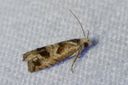
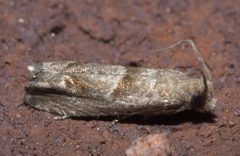
Eucosma apacheana is a small tortricid in the Tortricidae, Olethreutinae. The was described by Lord Walsingham in 1884 based on specimens from the southwestern United States. It belongs to the large Eucosma, whose members are commonly known as phaneta moths or eucosma moths. Like other Olethreutinae, the larvae are likely internal feeders in plant tissues, though specific associations for this species remain poorly documented. are small with relatively nondescript coloration typical of the genus.
Pronunciation
How to pronounce Eucosma apacheana: /juːˈkɒzmə əˌpætʃiˈænə/
These audio files are automatically generated. While they are not always 100% accurate, they are a good starting point.
Identification
Difficult to distinguish from other Eucosma based on external appearance alone; requires examination of genitalia. Male genitalia with distinctive valva shape and structure separate it from E. bobana and E. cocana, with which it has been historically confused. Forewing pattern lacks the strong contrasting markings seen in some related species. Dissection and comparison with reference specimens or published illustrations is necessary for reliable identification.
Images
Appearance
Small with wingspan approximately 12–18 mm. Forewings grayish-brown with variable darker markings, often with indistinct transverse bands. Hindwings pale gray, lighter than forewings. Body slender, with rough-scaled vertex. Genitalia characteristics (particularly in males) provide definitive identification and distinguish it from .
Habitat
Associated with arid and semi-arid regions of the southwestern United States; specific microhabitat preferences poorly documented. Likely occurs in scrubland and open woodland vegetation where plants grow.
Distribution
Southwestern United States, primarily Arizona and New Mexico; possibly extending into adjacent northern Mexico. Records are sparse and the true range may be broader than currently documented.
Seasonality
period appears to span late spring through summer, with most records from May to August. Specific poorly documented due to limited collecting.
Behavior
; attracted to light. Larval unknown; typically bore into stems, roots, or flower of plants.
Ecological Role
Larvae likely function as herbivores, potentially affecting of plant ; specific ecological impacts unknown.
Human Relevance
No documented economic importance; not known as a pest of agriculture or forestry.
Similar Taxa
- Eucosma bobanaOverlapping distribution and similar external appearance; distinguished by male genitalia structure and subtle differences in forewing pattern
- Eucosma cocanaSympatric in parts of range; external similarity requires genital dissection for separation
- Eucosma dorsisignatanaSimilar size and coloration; distinguished by more distinct forewing markings in most specimens
More Details
Taxonomic History
Originally described as Phaneta apacheana by Walsingham (1884). Transferred to Eucosma following revisions of North American Olethreutinae. The has received little modern taxonomic attention, and its phylogenetic relationships within Eucosma remain unresolved.
Research Needs
Critical gaps include: larval plant identification, complete description, and clarification of geographic range. Fresh material with associated biological data is needed to advance understanding of this poorly known .