
Coptotriche citrinipennella
(Clemens, 1859)
A small leaf-mining in the Tischeriidae, first described from North America in 1859. The is notable for its broad range across both chestnut (Castanea) and oak (Quercus) . Larvae create distinctive mines in leaves of their host plants. It occurs across eastern North America from Canada to the southern United States.
Pronunciation
How to pronounce Coptotriche citrinipennella: /ˌkɒptoʊˈtrɪki ˌsɪtrɪnɪpɛnˈɛlə/
These audio files are automatically generated. While they are not always 100% accurate, they are a good starting point.
Identification
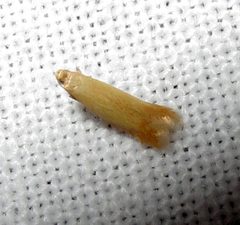
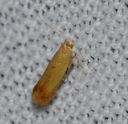
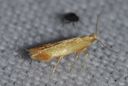
are small with yellowish forewings (implied by epithet 'citrinipennella', meaning lemon-yellow wing). Definitive identification requires examination of genitalia or larval mine characteristics. Larval mines are blotch-type with concentrated in one corner, distinguishing them from some related Tischeriidae.
Images
Habitat
Deciduous forests and woodlands containing trees, particularly areas with chestnut or oak . Found in both natural forest settings and urban/suburban environments where host trees are planted.
Distribution
Eastern North America: Canada (Nova Scotia, Ontario, Quebec) and United States (Arkansas, District of Columbia, Indiana, Kentucky, Massachusetts, Missouri, New Jersey, New York, North Carolina, Ohio, Pennsylvania, Texas, Virginia, West Virginia, Vermont).
Diet
Larvae feed as leaf miners on Castanea dentata (American chestnut), Castanea mollissima (Chinese chestnut), Castanea crenata (Japanese chestnut), Quercus coccinea (scarlet oak), Quercus ilicifolia (bear oak), Quercus imbricaria (shingle oak), Quercus marilandica (blackjack oak), Quercus palustris (pin oak), Quercus phellos (willow oak), and Quercus rubra (northern red oak).
Host Associations
- Castanea dentata - larval American chestnut
- Castanea mollissima - larval Chinese chestnut
- Castanea crenata - larval Japanese chestnut
- Quercus coccinea - larval scarlet oak
- Quercus ilicifolia - larval bear oak
- Quercus imbricaria - larval shingle oak
- Quercus marilandica - larval blackjack oak
- Quercus palustris - larval pin oak
- Quercus phellos - larval willow oak
- Quercus rubra - larval northern red oak
Life Cycle
Larvae mine leaves of plants, creating blotch mines with accumulated in one corner. occurs within the mine or in soil. Specific details of -laying, number of , and timing are not documented.
Behavior
Larvae are endophagous leaf miners, feeding internally between leaf epidermal layers. Mining creates visible damage on foliage.
Ecological Role
Herbivore that contributes to leaf damage in chestnut and oak . Role in as prey for and other natural enemies is likely but not documented.
Human Relevance
Minor potential as a pest of ornamental chestnuts and oaks. Not considered economically significant. Historical association with American chestnut may have relevance to chestnut restoration efforts.
Similar Taxa
- Other Coptotriche speciesSimilar leaf-mining habits on oaks; requires genitalia examination or specificity for separation
- Tischeria speciesRelated tischeriid leaf miners; distinguished by wing venation and genitalia characters
More Details
Original description
First described by James Brackenridge Clemens in 1859 under the basionym Tischeria citrinipennella, later transferred to Coptotriche.