
Astrotischeria
Puplesis & Diškus, 2003
trumpet leaf-miner moths
Species Guides
8Astrotischeria is a New World of micromoth leaf miners in the Tischeriidae, described in 2003. The genus is distributed across the Americas from the United States through the Caribbean and Central America to South America. Larvae are leaf miners, with most studied associated with plants in the Asteraceae family, particularly the Asteroideae. Some species exhibit a distinctive three-lobed male genital valva, a novel character for Tischeriidae. The genus includes at least 21 described species, with new species continuing to be discovered in the Neotropics.
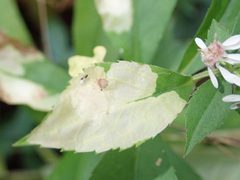
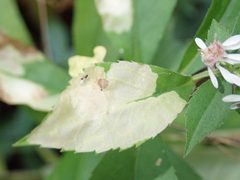
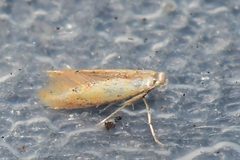
Pronunciation
How to pronounce Astrotischeria: //ˌæstroʊtɪʃˈiːriə//
These audio files are automatically generated. While they are not always 100% accurate, they are a good starting point.
Identification
-level identification within Astrotischeria relies heavily on examination of male genitalia, particularly the structure of the valva. Eleven species possess a highly modified valva with one and two lobes (the informal A. trilobata group). shows 6% divergence (K2P) between some congeneric species, though molecular data have raised questions about the monophyly of the . are small micromoths; specific wing patterns and coloration vary by species but require examination for reliable identification.
Images
Habitat
span temperate to tropical environments across the Americas, including tropical lowlands, Amazon Basin forests, and transverse valleys of the Atacama Desert. Specific habitat associations are often inferred from plant distributions rather than directly described.
Distribution
Distributed throughout the Americas: United States, Caribbean (St. Thomas), Central America (Belize, Guatemala, Honduras), and South America (Ecuador, Peru, Bolivia, Brazil, Chile, Colombia). The reaches its highest diversity in the Neotropics.
Host Associations
- Asteroideae (Asteraceae) - larval Primary association for most studied
- Ambrosia cumanensis (Asteraceae) - larval Confirmed for A. karsholti
- Verbesina (Asteraceae) - larval for A. mystica
- Oyedaea (Asteraceae) - larval for A. yungasi
- Baccharis (Asteraceae) - larval for A. parapallens
- Sida (Malvaceae) - larval for A. neotropicana; broader host range than typical for
Life Cycle
Larvae are leaf miners, feeding within leaf tissue and creating characteristic mines. can be reared from mining larvae using methods specifically adapted for Tischeriidae. Specific details on , pupal, and adult longevity vary by and are poorly documented for most .
Behavior
Larvae exhibit leaf-mining , feeding internally in leaves of plants. This concealed feeding habit is characteristic of the Tischeriidae.
Ecological Role
As leaf miners on Asteraceae and occasionally other plant , larvae may influence leaf physiology and plant . Their role in broader processes has not been studied.
Human Relevance
No direct economic importance documented. Some are associated with common Asteraceae weeds (Ambrosia, Baccharis), but impact on agriculture or forestry is negligible. Primarily of scientific interest for biodiversity assessment and studies of -plant specialization.
Similar Taxa
- CoptotricheAlso in Tischeriidae; both are leaf-mining micromoths. Coptotriche typically have different male genitalia and associations; Astrotischeria is distinguished by New World distribution and the distinctive three-lobed valva in some species.
- TischeriaType of Tischeriidae; primarily Old World distribution. Astrotischeria is restricted to the Americas and shows different patterns of -plant use and genitalic structure.
More Details
Taxonomic uncertainty
data have raised questions about the monophyly of Astrotischeria, suggesting that the current generic concept may require revision.
Rearing methods
Specialized methods for rearing from mining larvae have been developed specifically for Tischeriidae, facilitating biological study of these concealed-feeding insects.
Sources and further reading
- BugGuide
- Wikipedia
- GBIF taxonomy match
- NCBI Taxonomy
- Catalogue of Life
- American Asteraceae-feeding Astrotischeria species with a highly modified, three-lobed valva in the male genitalia (Lepidoptera, Tischeriidae)
- Astrotischeria neotropicana sp. nov.—a leaf-miner on Sida, Malvaceae, currently with the broadest distribution range in the Neotropics (Lepidoptera, Tischeriidae)
- Four Tischeriidae species in Colombia, including a new Astrotischeria species: is it not too little for a megadiverse country?
- A new distribution record, first host plant record and DNA barcoding of the Neotropical micromoth Astrotischeria karsholti Puplesis & Diškus (Lepidoptera, Tischeriidae)
- Documenting trumpet leaf-miner moths (Tischeriidae): new Neotropical Coptotriche and Astrotischeria species, with notes on Sapindaceae as a host-plant family
- Figure 4 from: Vargas HA (2023) A new distribution record, first host plant record and DNA barcoding of the Neotropical micromoth Astrotischeria karsholti Puplesis & Diškus (Lepidoptera, Tischeriidae). Biodiversity Data Journal 11: e115397. https://doi.org/10.3897/BDJ.11.e115397
- Supplementary material 2 from: Vargas HA (2023) A new distribution record, first host plant record and DNA barcoding of the Neotropical micromoth Astrotischeria karsholti Puplesis & Diškus (Lepidoptera, Tischeriidae). Biodiversity Data Journal 11: e115397. https://doi.org/10.3897/BDJ.11.e115397
- Figure 1 from: Vargas HA (2023) A new distribution record, first host plant record and DNA barcoding of the Neotropical micromoth Astrotischeria karsholti Puplesis & Diškus (Lepidoptera, Tischeriidae). Biodiversity Data Journal 11: e115397. https://doi.org/10.3897/BDJ.11.e115397
- Figure 2 from: Vargas HA (2023) A new distribution record, first host plant record and DNA barcoding of the Neotropical micromoth Astrotischeria karsholti Puplesis & Diškus (Lepidoptera, Tischeriidae). Biodiversity Data Journal 11: e115397. https://doi.org/10.3897/BDJ.11.e115397
- Supplementary material 1 from: Vargas HA (2023) A new distribution record, first host plant record and DNA barcoding of the Neotropical micromoth Astrotischeria karsholti Puplesis & Diškus (Lepidoptera, Tischeriidae). Biodiversity Data Journal 11: e115397. https://doi.org/10.3897/BDJ.11.e115397
- Figure 3 from: Vargas HA (2023) A new distribution record, first host plant record and DNA barcoding of the Neotropical micromoth Astrotischeria karsholti Puplesis & Diškus (Lepidoptera, Tischeriidae). Biodiversity Data Journal 11: e115397. https://doi.org/10.3897/BDJ.11.e115397