
Opogona
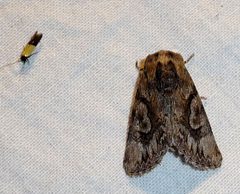
Opogona n-sp is an undescribed species in the Tineidae, a group of small commonly known as fungus moths or clothes moths. The Opogona contains several economically significant , including the Opogona crown borer (O. omoscopa), which has been documented attacking strawberries and bird of paradise plants in California. This undescribed species has been recorded in blacklighting surveys conducted at the Bohart Museum of Entomology at UC Davis, indicating it is part of the moth fauna of the region. As a newly recognized but not yet formally described species, its and distribution remain incompletely known.
Identification
Identification of Opogona n-sp requires expert examination of genitalia and other microscopic features, as in this are morphologically similar. The genus Opogona is characterized by narrow, elongate forewings with a somewhat pointed apex, and a relatively slender body. Distinguishing undescribed species from described such as O. omoscopa necessitates comparison with and detailed morphological analysis; no field identification characters have been published for this particular species.
Images
Habitat
Recorded from blacklighting setups in urban/suburban environments near the UC Davis campus, suggesting occurrence in modified landscapes of California's Central Valley. Other Opogona are associated with decaying plant material, fungi, or living plant tissues; the specific microhabitat requirements of this undescribed species are unknown.
Distribution
Known from Davis, California, USA based on blacklighting records from the Bohart Museum of Entomology. The full geographic range has not been determined.
Seasonality
Detected in early August during the Bohart Museum's Night event, indicating activity in summer. Additional seasonal data are lacking.
Behavior
are attracted to ultraviolet light sources, a recorded during standardized blacklighting surveys. This activity pattern is consistent with other members of the .
Similar Taxa
- Opogona omoscopaThe Opogona crown borer is a described with known pest status in California; O. n-sp would key near this and requires dissection to separate.
More Details
Undescribed species context
The designation 'n-sp' (new ) indicates this has been recognized by as distinct but not yet formally described in the scientific literature. Such designations are common in ongoing biodiversity surveys and museum collections.
Research context
This was documented during systematic blacklighting surveys conducted by John ' Man' De Benedictis and colleagues at the Bohart Museum of Entomology, UC Davis, as part of long-term monitoring of regional moth diversity.