
Oinophila
Stephens, 1848
Species Guides
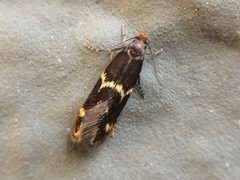
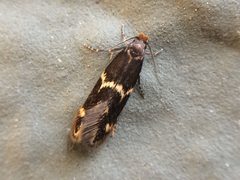
1- Oinophila v-flava(Yellow V Moth)
Oinophila is a small of fungus moths in the Tineidae, Hieroxestinae. The genus name derives from Greek roots meaning "wine-lover," reflecting the association of its best-known with wine cellars. The genus contains four nominal species, though two are provisionally placed and may not belong to this genus or even to Hieroxestinae. The most notable species, Oinophila v-flava, is commonly known as the wine .
Pronunciation
How to pronounce Oinophila: //ɔɪˈnɒfɪlə//
These audio files are automatically generated. While they are not always 100% accurate, they are a good starting point.
Identification
The is distinguished within Hieroxestinae by its small size and association with fungal substrates in stored products. -level identification requires examination of genitalia; external alone is insufficient. Oinophila v-flava can be recognized by the distinctive V-shaped yellow marking on the forewing, referenced in its specific epithet. The genus has historically served as a "wastebin " for miscellaneous Hieroxestinae, complicating identification.
Images
Habitat
in this are associated with human-modified environments, particularly damp cellars and storage areas where wine bottles are kept. Larvae require moist conditions and are found in cork substrates where mold growth occurs.
Distribution
Distribution records exist for Norway (NO) and Sweden (SE). The wine (Oinophila v-flava) has been observed in California, USA, at blacklighting events. The likely has broader distribution in association with wine storage facilities, but precise range data are limited.
Seasonality
have been recorded at blacklight in July and August. Activity likely coincides with warm, humid conditions favorable to mold growth in cellars.
Diet
Larvae feed primarily on mold growing on moist cork. The diet is fungal rather than keratinaceous, distinguishing this from many other Tineidae.
Host Associations
- cork - larval substratemoist cork of wine bottles
- fungi - food sourcemold growing on cork
Life Cycle
Complete with , larval, pupal, and stages. Larvae burrow into moist cork to feed on mold. occurs within the substrate. Adults are short-lived and do not feed.
Behavior
Larvae actively burrow into cork in search of fungal food sources. are attracted to ultraviolet light and have been collected at blacklighting events.
Ecological Role
Decomposer, facilitating nutrient cycling through consumption of mold in human-modified environments.
Human Relevance
Oinophila v-flava is a minor pest of wine cellars, where larval tunneling in cork can damage wine bottle seals. The damage is primarily to packaging rather than wine quality. The is not considered economically significant compared to other stored-product pests.
Similar Taxa
- Nemapogon cloacellaAlso a tineid associated with wine cork; distinguished by different wing pattern and larval habits
- Tineola bisselliellaConvergent association with human dwellings, but feeds on keratin rather than fungi and belongs to a different (Tineinae)
More Details
Taxonomic Uncertainty
Two of the four nominal (O. argyrospora and O. xanthorrhabda) are provisionally placed in this and may require reclassification. The genus has a history of serving as a repository for poorly understood Hieroxestinae.
Nomenclatural Note
The epithet v-flava is frequently misspelled as "v-flavum" in literature and online sources.
Sources and further reading
- BugGuide
- Wikipedia
- GBIF taxonomy match
- iNaturalist taxon
- NCBI Taxonomy
- Catalogue of Life
- Like a Moth to a Flame: Moth Night at Bohart Museum of Entomology | Bug Squad
- Bohart Museum of Entomology: One Busy Place! | Bug Squad
- Scarab Beetles First to Arrive at UC Davis 'Moth Night' | Bug Squad
- Oinophila v-flava Archives - Entomology Today
- In Defense of Clothes Moths, Marvels of Evolution