
Dryadaula
Meyrick, 1893
Species Guides
2- Dryadaula terpsichorella(dancing moth)
- Dryadaula visaliella
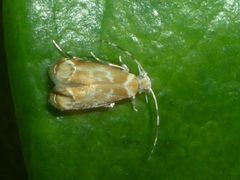
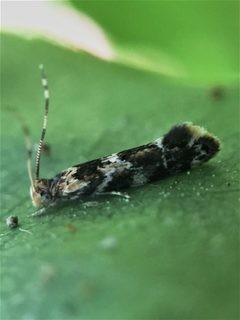
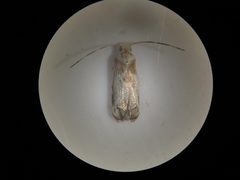
Dryadaula is a of small in the Dryadaulidae (formerly placed in Tineidae), established by Edward Meyrick in 1893. The genus comprises approximately 60 described distributed across the Palaearctic region, with additional records from Hawaii and other regions. Species are characterized by small size (wingspans typically 7-15 mm), inconspicuous coloration, and concealed lifestyles associated with dead wood and fungal . Several species have been described in recent decades, including four new species from China in 2021 and one from Japan in 2024, indicating ongoing taxonomic discovery.
Pronunciation
How to pronounce Dryadaula: /dɹaɪəˈdɔːlə/
These audio files are automatically generated. While they are not always 100% accurate, they are a good starting point.
Identification
Distinguished from other Tineoidea by the combination of small size, asymmetrical male genitalia, and association with bracket fungi or dead wood . Within Dryadaulidae, identification requires examination of genitalia and forewing pattern details. D. caucasica: grey forewings with black markings, wingspan ~11 mm. D. epischista: orange forewing ground color with brown and white pattern. D. orientalis: similar to D. epischista but distinguished by genitalia and (1.52-1.83% divergence).
Images
Habitat
Old-growth and mature forests with continuity of dead wood. Mesophilous mixed broadleaved forest stands, both managed (80+ years) and strict nature reserves (180+ years). Specific microhabitats include dead standing or fallen trunks of aspen and oak bearing sporocarps of bracket fungi (Polyporales).
Distribution
Palaearctic region: Europe (Poland, Germany, Greece), Caucasus (Azerbaijan), Russia (European Russia, Lake Baikal region, Ussuri), East Asia (China, Korea, Japan). Hawaii (D. terpsichorella). Records from Sweden and Norway in GBIF. Many likely more widely distributed but overlooked due to concealed lifestyle.
Seasonality
activity generally May-September. D. caucasica: May-July. D. epischista and D. orientalis: July-September. Specific varies by and latitude.
Diet
Larvae develop inside sporocarps of bracket fungi (Polyporales). D. caucasica reared from Phellinus tremulae. do not feed.
Host Associations
- Phellinus tremulae - larval development confirmedPolyporales; sporocarp substrate for D. caucasica larvae
- Bjerkandera adusta - present at capture siteresupinate fungus, Polyporales
- Ganoderma applanatum - present at capture sitebracket fungus, Polyporales
- Populus tremula - dead wood substrateaspen trunks bearing fungal sporocarps
- Quercus robur - dead wood substrateoak trunks bearing fungal sporocarps
Life Cycle
and larval stages unknown for most . Larvae develop concealed within fungal sporocarps. Pupa: male of D. caucasica 4 mm long, 1.5 mm wide. timing varies by species and region.
Behavior
Concealed lifestyle; larvae develop inside fungal sporocarps. generally inconspicuous. Some attracted to light (D. caucasica female at type locality; D. epischista, D. orientalis collected by light trap). D. terpsichorella exhibits distinctive 'dancing' . Adults of some species captured in or barrier traps near dead wood with fungi.
Ecological Role
Saproxylic mycophagous contributing to decomposition of bracket fungi in old-growth forest . Dependent on continuity of dead wood and associated fungal . Component of saproxylic Lepidoptera community in primeval forest .
Human Relevance
No direct economic importance. Subject of conservation interest as indicator of old-growth forest continuity and saproxylic biodiversity. Taxonomic study material for of Tineoidea.
Similar Taxa
- Other Tineidae/Dryadaulidae generaDistinguished by asymmetrical male genitalia and specific association with bracket fungi; other tineids often associated with keratinaceous materials, lichens, or leaf litter
- NemapogonSimilar small size and mycophagy, but Nemapogon typically have different genitalia symmetry and often associated with different fungal substrates
More Details
Taxonomic History
Originally described in Tineidae; now placed in separate Dryadaulidae in most recent classifications. Dryadaulinae when treated within Tineidae.
Research Methods
Best collected by rearing from bracket fungus sporocarps or using barrier traps and interception devices near dead wood with fungi. Light trapping effective for some . useful for species delimitation.
Sources and further reading
- BugGuide
- Wikipedia
- GBIF taxonomy match
- iNaturalist taxon
- NCBI Taxonomy
- Catalogue of Life
- Behavior of the Hawaiian Dancing Moth,Dryadaula terpsichorella(Tineidae: Dryadaulinae)
- First report of Dryadaula caucasica (Zagulajev, 1970) from Central Europe and records of further rare tineids (Lepidoptera: Tineidae) in Białowieża Primeval Forest
- A new species of the genus Dryadaula Meyrick (Lepidoptera, Dryadaulidae) from Japan, with a redescription of D.epischista (Meyrick, 1936).
- The genus Dryadaula Meyrick (Lepidoptera, Tineoidea, Dryadaulidae) in China, with descriptions of four new species and a world checklist.