
Dryadaulidae
Bradley, 1966
Genus Guides
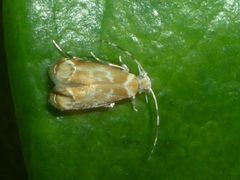
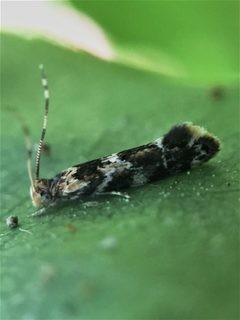
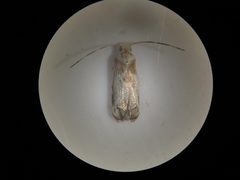
1Dryadaulidae is a of small (Lepidoptera) established in 2015 based on molecular phylogenetic analysis of Tineoidea. The family comprises two : Dryadaula (approximately 50 worldwide) and Brachydoxa (two species in the Oriental Region). These moths were previously classified within Tineidae. are minute, with wingspans not exceeding 20 mm and forewing lengths of 2.7–3.2 mm.
Pronunciation
How to pronounce Dryadaulidae: /draɪəˈdɔːlɪdiː/
These audio files are automatically generated. While they are not always 100% accurate, they are a good starting point.
Identification
Distinguished from Tineidae and other Tineoidea by strongly asymmetrical male genitalia with to right valva and absence of gnathos. The reduced female oviscapt with is diagnostic. Small size (wingspan under 20 mm) and minute forewing length (under 3.2 mm) separate Dryadaula from most Tineidae. Brachydoxa, the second , is restricted to the Oriental Region and differs in genital structure.
Images
Appearance
are extremely small with wingspans no more than 20 mm. Forewing length ranges 2.7–3.0 mm in males and 2.8–3.2 mm in females. Some exhibit orange forewings with brown and white patterning. Male genitalia are highly modified and asymmetrical, incorporating parts of sternum VII and VIII, with the to the right valva; gnathos is absent. Females possess a reduced oviscapt with or absent .
Distribution
Worldwide across all zoogeographical regions: 14 in Palearctic, 16 in Neotropics, 1 in Nearctic, 2 in Afrotropics, 4 in Indomalaya, 12 in Australia, and 2 in Oceania. Specific country records include China, Japan, South Korea, Russia, numerous European countries, Azerbaijan, Ethiopia, Guyana, Grenada, Brazil, Mexico, Peru, Ecuador, United States (including Hawaii), and Fiji.
Seasonality
of at least some are active from July to September. Collection records indicate both daytime and activity.
Behavior
have been collected by sweep netting during daytime and at light sources (250-W high-pressure mercury lamps, LED UV lamps) at night. have also captured adults. These collection methods suggest both and activity.
Similar Taxa
More Details
Taxonomic history
The was proposed by Regier et al. (2015) based on molecular phylogenetic study and formally includes the former tineid Dryadaula Meyrick, 1893 and Brachydoxa Meyrick, 1917.
Molecular data
barcodes (COI sequences) have been generated for multiple to support phylogenetic placement and species identification.
Sources and further reading
- BugGuide
- GBIF taxonomy match
- iNaturalist taxon
- NCBI Taxonomy
- Catalogue of Life
- A new species of the genus Dryadaula Meyrick (Lepidoptera, Dryadaulidae) from Japan, with a redescription of D.epischista (Meyrick, 1936).
- The genus Dryadaula Meyrick (Lepidoptera, Tineoidea, Dryadaulidae) in China, with descriptions of four new species and a world checklist.