
Meskea
Grote, 1877
Species Guides
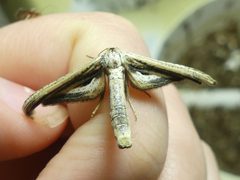
1- Meskea dyspteraria(Window-winged Moth)
Meskea is a of in the Thyrididae, Siculodinae. in this genus are gall-forming herbivores whose larvae develop within stem galls on plants in the family Malvaceae. The genus includes at least two documented species: Meskea horor, a potential agent studied for its impact on weedy Sida species, and Meskea dyspteraria, which has been recorded as a host for the Calliephialtes grapholithae. moths are or in habit.
Pronunciation
How to pronounce Meskea: //ˈmɛs.keɪ.ə//
These audio files are automatically generated. While they are not always 100% accurate, they are a good starting point.
Identification
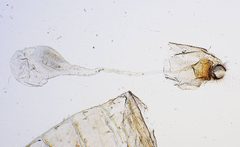
Meskea can be distinguished from other Thyrididae by their gall-forming larval and association with Malvaceae plants. are small with the characteristic wing venation patterns of the Thyrididae, which typically feature reticulate or window-like wing patterns. Specific identification to species level requires examination of genitalia or larval host associations.
Images
Habitat
Associated with plants in the Malvaceae, particularly Sida acuta and Sida rhombifolia. Field studies have been conducted in tropical and subtropical regions where these host plants occur.
Distribution
Documented from Mexico (Veracruz) in studies of Meskea horor; broader distribution across the Americas likely given plant ranges but not explicitly documented in available sources.
Diet
Larvae feed internally within stem galls on Malvaceae plants. in laboratory conditions have been observed feeding on flowers of Sida acuta, Sida rhombifolia, and Hibiscus sabdariffa, as well as drinking water or dilute honey solution; field feeding by adults has not been observed.
Host Associations
- Sida acuta - Gall-forming herbivoreLarval development in stem galls; primary for studies
- Sida rhombifolia - Gall-forming herbivoreLarval development in stem galls; primary for studies
- Hibiscus sabdariffa - feedingLaboratory observation only; flowers used as food source
- Chalcoela iphitalis - Indirect associationMeskea dyspteraria caterpillars have been found in Polistes metricus nests, suggesting possible predatory or parasitic relationship with wasp larvae
Life Cycle
to development time approximately 192 days for Meskea horor. Adults live 11–14 days. Eggs are laid mainly on the underside of leaves. Larvae bore into stems and form galls, where they complete development. occurs within the gall.
Behavior
emerge early in the morning and are typically inactive during daylight hours. Larval gall formation retards plant growth and flowering. Some or may have complex ecological relationships, including possible association with paper wasp nests.
Ecological Role
Gall-forming herbivore that acts as a plant stressor, reducing growth and reproductive output of Malvaceae . Serves as host for including Calliephialtes grapholithae. Considered unsuitable as a agent due to broad host range within Malvaceae.
Human Relevance
Studied as a potential agent for weedy Sida (Sida acuta and Sida rhombifolia), but rejected due to broad range that includes economically important Malvaceae species.
Similar Taxa
- Other Thyrididae generaSimilar ; distinguished by larval and associations
- Other gall-forming LepidopteraConvergent gall-forming habit; distinguished by -level characteristics including wing venation and
More Details
Biological control evaluation
Meskea horor was evaluated for of Sida acuta and S. rhombifolia in Mexico. range testing on 48 plant showed from seven Malvaceae species and larval gall formation (but mortality before ) on 17 additional species, indicating too broad a host range for safe introduction as a biological control agent.
Complex ecological associations
Meskea dyspteraria has been documented in an unusual ecological context: caterpillars were found in an abandoned nest of the paper wasp Polistes metricus, suggesting possible on larvae similar to the related Chalcoela iphitalis. This association requires further documentation to confirm.
Sources and further reading
- BugGuide
- GBIF taxonomy match
- iNaturalist taxon
- NCBI Taxonomy
- Catalogue of Life
- Bug Eric: A Potential New Host Record for Calliephialtes grapholithae (Hymenoptera: Ichneumonidae) from a Paper Wasp nest (Hymenoptera: Vespidae: Polistes metricus)
- Life cycle and host range of the gall-forming moth,Meskea horor (Lep.: Thyrididae), and its suitability as a biological control agent forSida acuta andS. rhombifolia (Malvaceae) Cycle biologique, gamme d’hôtes et potentialités d’utilisation deMeskea horor (Lep. : Thyrididae) comme agent de lutte biologique contreSida acuta etS. rhombifolia (Malvaceae)