
Hypsopygia olinalis
(Guenée, 1854)
Yellow-fringed Dolichomia Moth, yellow-fringed dolichomia
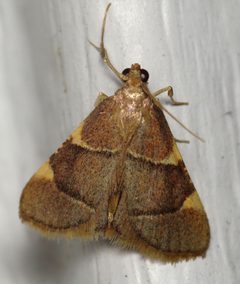
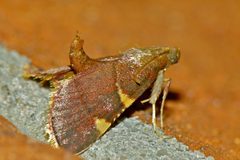
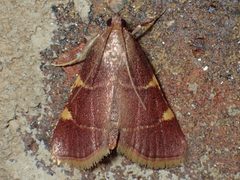
A small pyralid of eastern North America, Hypsopygia olinalis is recognized by its distinctive yellow fringe along the wing margins. The has a wingspan of 16–24 mm and exhibits a bimodal pattern with active from May through August in the northern part of its range and extending into September farther south. Larvae are documented feeders on Quercus species.
Pronunciation
How to pronounce Hypsopygia olinalis: /hɪpˌsɒˈpɪdʒiə oʊˈlaɪnəlɪs/
These audio files are automatically generated. While they are not always 100% accurate, they are a good starting point.
Identification
The yellow fringe on the wing margins is diagnostic for this within its range. Hypsopygia binodulalis (Pink-fringed Dolichomia), a related species also formerly placed in Dolichomia, has pink rather than yellow fringe. Other small pyralids in eastern North America lack this distinctive marginal coloration.
Images
Habitat
Associated with oak-containing given larval relationship with Quercus . Specific habitat preferences for not documented.
Distribution
Eastern North America. Documented from Vermont and broadly across the eastern United States.
Seasonality
active May–August in the American Northeast; May–September in North Carolina. Bimodal with extended period in southern portions of range.
Diet
Larvae feed on Quercus (oak) . feeding habits not documented.
Host Associations
- Quercus - larval food plantLarvae feed on oak
Life Cycle
Complete with documented larval stage feeding on oak foliage. Specific details of , pupal stages, and number of not documented in available sources.
Behavior
are and attracted to light. Specific behavioral details beyond period not documented.
Ecological Role
Larval herbivore on oaks, contributing to nutrient cycling in oak-dominated . Role as prey or not documented.
Human Relevance
No documented economic or medical significance. Occasionally encountered by enthusiasts at light traps.
Similar Taxa
- Hypsopygia binodulalisAlso formerly placed in Dolichomia; distinguished by pink rather than yellow wing fringe
More Details
Taxonomic History
Formerly placed in Dolichomia, reflected in "yellow-fringed dolichomia"