
Dioryctria pygmaeella
Ragonot, 1887
baldcypress coneworm moth, cypress coneworm moth
Dioryctria pygmaeella is a snout moth in the Pyralidae, described by Émile Louis Ragonot in 1887. The is restricted to the coastal plains of the eastern United States and eastern Texas. Larvae feed within the cones of baldcypress (Taxodium distichum) and pondcypress (Taxodium ascendens). The species completes up to three annually.
Pronunciation
How to pronounce Dioryctria pygmaeella: //ˌdaɪ.əˈɹɪk.tri.ə pɪɡˈmiː.ɛl.lə//
These audio files are automatically generated. While they are not always 100% accurate, they are a good starting point.
Identification
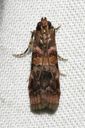
A small pyralid , typically 10–15 mm in length. As a member of the Dioryctria, it possesses the characteristic projecting labial palps that form a prominent "snout." are generally grayish-brown with variable darker markings. Accurate identification to level typically requires examination of genitalia or molecular analysis, as Dioryctria species are morphologically similar.
Images
Habitat
Associated with wetland forests dominated by Taxodium , particularly baldcypress swamps and pondcypress stands. The species requires mature trees bearing cones for larval development.
Distribution
Restricted to the coastal plains of the eastern United States and eastern Texas.
Seasonality
Active across multiple annually, with up to three generations per year reported. periods span the growing season in association with tree .
Diet
Larvae feed within the cones of Taxodium distichum (baldcypress) and Taxodium ascendens (pondcypress). The specific diet of is not documented.
Host Associations
- Taxodium distichum - larval larvae feed within cones
- Taxodium ascendens - larval larvae feed within cones
Life Cycle
Up to three per year. Larvae develop within cypress cones, feeding on cone tissues. occurs within the cone or in surrounding debris.
Ecological Role
Larvae act as cone-feeding , potentially affecting seed production in cypress . The functions as a for , including congenerics that have been studied for potential.
Human Relevance
May impact seed production in cypress stands managed for timber or conservation purposes. The is not considered a major economic pest. Related Dioryctria species are significant pests of conifer crops, prompting research into agents that may have implications for understanding this species' natural enemies.
Similar Taxa
- Dioryctria auranticellaAlso a coneworm feeding in conifer cones, but associated with pines (Pinus ponderosa) in western North America rather than cypress in the southeastern coastal plain. are similarly small with snout-like palps.
- Dioryctria abietellaEuropean coneworm with similar larval habit of feeding in conifer cones; distinguished by geographic separation and preference for Abies and Picea.
Sources and further reading
- BugGuide
- Wikipedia
- GBIF taxonomy match
- iNaturalist taxon
- Baryscapus dioryctriae Archives - Entomology Today
- Baryscapus dioryctriae - Entomology Today
- Bug Eric: New Mexico Night Bugs
- Bug Eric: My Personal National Moth Week, 2017
- Bug Eric: September 2017
- New Wasp Species Discovered Parasitizing Pests of Pine Trees