
Acrobasis caryae
Grote, 1881
Hickory Shoot Borer, Hickory Shoot Borer Moth
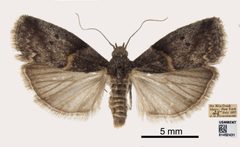
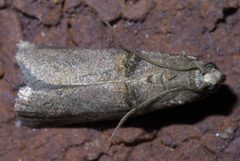
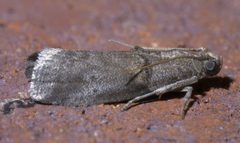
Acrobasis caryae is a snout moth ( Pyralidae) commonly known as the hickory shoot borer. The was described by Augustus Radcliffe Grote in 1881 and occurs in southeastern Ontario and the eastern United States. Larvae are specialized feeders on hickory species (Carya), developing within the shoots of their plants.
Pronunciation
How to pronounce Acrobasis caryae: /ˌækroʊˈbeɪsɪs ˈkɛəri.iː/
These audio files are automatically generated. While they are not always 100% accurate, they are a good starting point.
Images
Habitat
Associated with hickory forests and woodlands where plants of the Carya occur.
Distribution
Southeastern Ontario, Canada, and the eastern United States.
Diet
Larvae feed on Carya , including Carya cordiformis, Carya tomentosa, Carya pallida, Carya glabra, Carya ovata, and Carya carolinae-septentrionalis. Larvae feed within the shoots of their plant.
Host Associations
- Carya cordiformis - larval
- Carya tomentosa - larval
- Carya pallida - larval
- Carya glabra - larval
- Carya ovata - larval
- Carya carolinae-septentrionalis - larval
More Details
Parasitoid relationships
Acrobasis caryae has been documented as a for the ichneumon Calliephialtes grapholithae (Hymenoptera: Ichneumonidae). This is known to attack concealed caterpillars of several Acrobasis .
Taxonomic note
The iNaturalist record lists 'Hickory Shoot Borer and Allies' as a preferred , suggesting potential broader grouping, though sources consistently treat A. caryae as a distinct .
Sources and further reading
- BugGuide
- Wikipedia
- GBIF taxonomy match
- iNaturalist taxon
- NCBI Taxonomy
- Catalogue of Life
- Gall darn it! Gall insects on hickory, oak, and elm, Phylloxera caryaecaulis, Andricus palustris, Colopha ulmicola — Bug of the Week
- Pecan Nut Casebearer: New Guide Provides IPM Options
- Bug Eric: Wasp Wednesday: Mesostenus
- When is a locust borer not a locust borer? | Beetles In The Bush
- Bug Eric: A Potential New Host Record for Calliephialtes grapholithae (Hymenoptera: Ichneumonidae) from a Paper Wasp nest (Hymenoptera: Vespidae: Polistes metricus)
- Bug Eric: February 2009