
Anageshna primordialis
Dyar, 1906
Yellow-spotted Webworm Moth
Anageshna primordialis, known as the yellow-spotted webworm , is a crambid moth described by Harrison Dyar in 1906. The species is widely distributed across the eastern and central United States, with records spanning from Maine to Florida and westward to Texas and Arizona. It is a moderately well-documented species with nearly 10,000 observations on iNaturalist, indicating it is frequently encountered by naturalists.
Pronunciation
How to pronounce Anageshna primordialis: //ˌænəɡɛʃˈnə praɪˌmɔrdiˈælɪs//
These audio files are automatically generated. While they are not always 100% accurate, they are a good starting point.
Identification
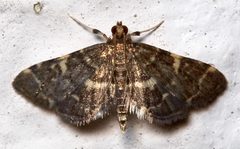
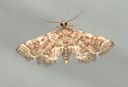
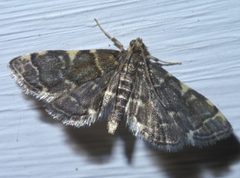
Distinguished from similar small crambid by the combination of brown forewings with contrasting yellow-orange spots and pale hindwings. The spotted pattern differs from unmarked or striped in the same size range. Genitalia examination may be required for definitive separation from congeneric species.
Images
Appearance
have brown forewings with yellow-orange spots arranged in a distinctive pattern; hindwings are pale. Wingspan approximately 15–20 mm. Larvae are known to produce silk webbing on plants, giving rise to the .
Habitat
Associated with wooded and semi-open where larval plants occur; frequently found in suburban and rural settings with sufficient vegetation.
Distribution
Eastern and central United States: Alabama, Arkansas, Arizona, Florida, Georgia, Iowa, Illinois, Kansas, Louisiana, Massachusetts, Maryland, Maine, Minnesota, Missouri, Mississippi, North Carolina, New Hampshire, New Jersey, New York, Ohio, Oklahoma, Pennsylvania, South Carolina, Texas, Vermont, Virginia, and West Virginia.
Seasonality
have been recorded from spring through fall in most of the range; peak activity varies regionally. Multiple per year likely in southern portions of range.
Behavior
Larvae construct silk webbing on plants, feeding within the shelter. are and attracted to light.
Ecological Role
Larvae function as herbivores, potentially contributing to nutrient cycling through leaf consumption and webbing production. Specific ecological impacts are not well documented.
Human Relevance
Occasionally encountered by gardeners and naturalists; not considered an agricultural or ornamental pest of significance. Frequently photographed and documented by citizen scientists.
Similar Taxa
- Other Anageshna speciesSimilar size and general appearance; requires examination of spot pattern or genitalia for separation.
- Small Spilomelinae mothsMany share brown coloration and small size; yellow spotting pattern of A. primordialis is distinctive.
More Details
Taxonomic history
Originally described as Geshna primordialis by Dyar in 1906, later transferred to Anageshna. Authority sometimes cited as (Dyar, 1907) in some sources.
Citizen science documentation
With nearly 10,000 iNaturalist observations, this is among the more frequently documented North American crambid , providing substantial data on distribution and .