
Salbia
Guenée, 1854
Species Guides
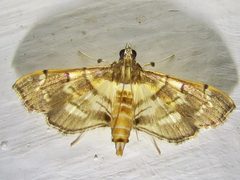
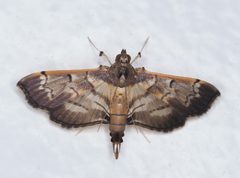
4Salbia is a of crambid ( Crambidae, Pyraustinae) established by Achille Guenée in 1854. The genus contains leaf-rolling , including Salbia lotanalis, which has been studied as a potential agent for the tree Miconia calvescens. Larvae feed on Melastomataceae and construct leaf rolls for shelter.
Pronunciation
How to pronounce Salbia: //ˈsal.bi.a//
These audio files are automatically generated. While they are not always 100% accurate, they are a good starting point.
Images
Habitat
Tropical and subtropical regions; associated with Melastomataceae plants. Salbia lotanalis occurs in Rican field sites near San José.
Distribution
Rica (documented for S. lotanalis); broader distribution of not specified in available sources.
Diet
Larvae of S. lotanalis feed on leaves of Miconia calvescens and other Melastomataceae. -specificity tests indicate a narrow host range restricted to Miconia spp. and related Melastomataceae.
Host Associations
- Miconia calvescens - Primary for S. lotanalis; tree in Hawaii and other regions
- Melastomataceae - Narrow range demonstrated in laboratory feeding and oviposition tests
Life Cycle
S. lotanalis completes five larval instars, determined by capsule width measurements. Larvae are initially gregarious, becoming solitary from third instar onward. First- through fourth-instar larvae preferentially occupy existing leaf rolls made by other larvae; fifth-instar larvae prefer constructing new leaf rolls. occurs within leaves, where build pupation chambers. Development time from to : 71.3 days (females), 66.4 days (males) at laboratory conditions. Females can lay more than 400 eggs based on dissections.
Behavior
Larvae exhibit leaf-rolling , constructing shelters from plant foliage. Early instars show gregarious tendencies; later instars become solitary and may compete for leaf roll resources. Fifth-instar larvae display distinct behavioral shift toward independent shelter construction rather than co-occupancy.
Ecological Role
Potential agent for Miconia calvescens. In native Rican , levels are low. Effectiveness may be reduced in introduced ranges due to interference from resident natural enemies of Lepidoptera.
Human Relevance
Investigated for of Miconia calvescens, an tree threatening native in Hawaii and other Pacific islands. Laboratory rearing protocols have been established on plant seedlings.
Similar Taxa
- Other Crambidae leaf rollersSimilar leaf-rolling larval ; distinguished by specificity to Melastomataceae and detailed chaetotaxy of final-instar larvae in S. lotanalis
More Details
Taxonomic history
described by Achille Guenée in 1854 within Crambidae, Pyraustinae. Classification confirmed by Catalogue of Life and GBIF as accepted genus.
Research focus
Most detailed biological studies focus on S. lotanalis due to applied interest in weed . Other within lack comparable documentation in provided sources.
Sources and further reading
- BugGuide
- Wikipedia
- GBIF taxonomy match
- iNaturalist taxon
- NCBI Taxonomy
- Catalogue of Life
- Penguuatan Perilaku Salbia Sebagai Alternatif Perilaku Rasional Birokrasi pada Pemilihan Umum
- Biology of the leaf roller Salbia lotanalis and its impact on the invasive tree Miconia calvescens
- Biology, Behavior, and Larval Morphology of Salbia lotanalis (Lepidoptera: Crambidae), a Potential Biological Control Agent of Miconia calvescens (Myrtales: Melastomataceae) from Costa Rica