
Orphanostigma haemorrhoidalis
(Guenée, 1854)
Lantana Leaftier
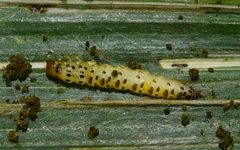
Orphanostigma haemorrhoidalis, commonly known as the leaftier, is a crambid native to the Neotropical region including South America, Central America, Mexico, the Antilles, and the southern United States. The has been deliberately introduced to several regions outside its native range—Hawaii (1956), Queensland (1958), Réunion, and Mauritius—as a agent targeting Lantana species. First described by Achille Guenée in 1854, this moth is also known under the synonym Salbia haemorrhoidalis. Its derives from the larval habit of tying leaves together with silk.
Pronunciation
How to pronounce Orphanostigma haemorrhoidalis: //ɔːrˌfæn.oʊˈstɪɡ.mə ˌhɛm.əˌrɔɪˈdeɪ.lɪs//
These audio files are automatically generated. While they are not always 100% accurate, they are a good starting point.
Images
Distribution
Native to South America, Central America, Mexico, the Antilles, and the southern United States. Introduced to Hawaii (1956), Queensland, Australia (1958), Réunion, and Mauritius for purposes. GBIF records indicate presence in South Africa.
Diet
Larvae feed on leaves of .
Host Associations
- Lantana - larval food plantPrimary ; targeted for of
Behavior
Larval includes tying leaves together with silk, which gives rise to the "leaftier."
Ecological Role
Used as a agent to suppress in introduced regions.
Human Relevance
Deliberately introduced to Hawaii, Queensland, Réunion, and Mauritius as a biocontrol agent for . No other documented human interactions.
More Details
Taxonomic note
The has been treated under the Salbia in some sources (as Salbia haemorrhoidalis), but is currently classified in Orphanostigma. GBIF lists it as a synonym of Salbia haemorrhoidalis.