
Palpita freemanalis
Munroe, 1952
Freeman's Palpita Moth
Palpita freemanalis is a small crambid in the Spilomelinae, described by Eugene G. Munroe in 1952. It occurs across the southeastern and central United States, with active primarily during late summer. The is characterized by its modest size and relatively broad geographic distribution within its range.
Pronunciation
How to pronounce Palpita freemanalis: //ˈpæl.pɪ.tə ˌfriːˈmæn.əˌlɪs//
These audio files are automatically generated. While they are not always 100% accurate, they are a good starting point.
Identification
The small wingspan (20–22 mm) distinguishes Palpita freemanalis from larger crambid . Definitive identification requires examination of genitalia or molecular analysis, as external features overlap with . The species occurs in regions where other Palpita species may be present, necessitating careful comparison.
Images
Appearance
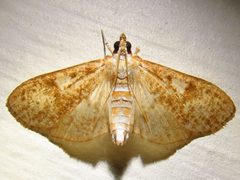
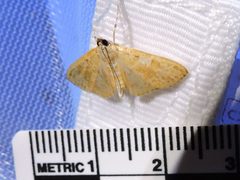
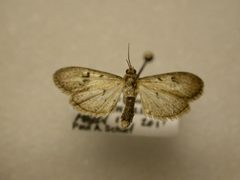
have a wingspan of 20–22 mm. The exhibits the general typical of the Palpita, with relatively narrow forewings and somewhat broader hindwings. Coloration and pattern details are not well documented in available sources.
Distribution
Recorded from Alabama, Illinois, Indiana, Louisiana, Maryland, Mississippi, North Carolina, Oklahoma, South Carolina, Tennessee, and Texas. The distribution spans the southeastern and central United States.
Seasonality
have been recorded from March to September, with the majority of records occurring in August. This suggests a primarily late-summer period, though some individuals emerge earlier in the season.
Similar Taxa
- Other Palpita species share similar size range and general ; definitive separation requires detailed examination
More Details
Taxonomic history
Described by Eugene G. Munroe in 1952, the epithet freemanalis presumably honors an individual with the surname Freeman, though the etymology is not explicitly documented in available sources.