
Lineodes fontella
Walsingham, 1913
Eastern Lineodes Moth
Lineodes fontella, commonly known as the eastern lineodes , is a small crambid moth described by Walsingham in 1913. It is widely distributed across the southeastern United States, the Caribbean, and parts of Central and South America. The is notable for its specialized larval association with Physalis fruits.
Pronunciation
How to pronounce Lineodes fontella: /lɪˈneɪ.oʊ.diːz fɒnˈtɛl.ə/
These audio files are automatically generated. While they are not always 100% accurate, they are a good starting point.
Identification
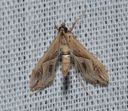
Distinguished from similar Lineodes by its pale tan wing coloration and geographic distribution. The small size (12–23 mm wingspan) and association with Physalis plants may aid identification where host plants are present. Specific diagnostic features separating it from are not documented in available sources.
Images
Appearance
A small with wingspan of 12–23 mm. Wings are pale tan in color. Larvae are pale in coloration.
Habitat
Found in regions where Physalis plants occur. Specific preferences beyond host plant association are not documented.
Distribution
United States: Florida, North Carolina, South Carolina, Texas. Caribbean: Jamaica, Cuba, Dominican Republic. Central America: Mexico, Panama, Guatemala, Honduras. South America: Brazil, French Guiana, Guyana.
Seasonality
are on wing year-round in Florida. In other parts of the United States, adults occur between August and November. Larvae have been found from April to October.
Diet
Larvae feed on the fruit of Physalis angulata, Physalis philadelphica, Physalis pubescens, Physalis viscosa, and Physalis walteri. diet is not documented.
Host Associations
- Physalis angulata - larval food plantfruit
- Physalis philadelphica - larval food plantfruit
- Physalis pubescens - larval food plantfruit
- Physalis viscosa - larval food plantfruit
- Physalis walteri - larval food plantfruit
Life Cycle
Larval stage occurs from April to October. Specific details on , pupal stages, or number of per year are not documented.
Ecological Role
Larval fruit-feeding on Physalis suggests a role as a frugivore and potential seed in where these plants occur.
Human Relevance
May be of minor agricultural concern where Physalis are cultivated, though specific economic impact is not documented.
Similar Taxa
- Other Lineodes speciesCongeneric share similar and may overlap in distribution; specific distinguishing characters for L. fontella are not well documented
More Details
Year-round activity in Florida
Unlike in other parts of its US range where activity is restricted to late summer and fall, Florida populations are active throughout the year, suggesting to the subtropical climate.