
Pantographa limata
Grote & Robinson, 1867
Basswood Leafroller Moth
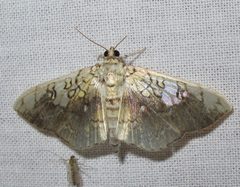
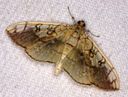
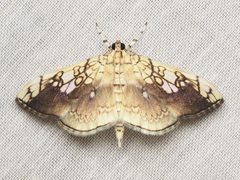
Pantographa limata, commonly known as the basswood leafroller , is a crambid moth native to eastern North America. have a wingspan of approximately 38 mm. The larvae are leafrollers that feed on Tilia , constructing shelters by rolling plant leaves.
Pronunciation
How to pronounce Pantographa limata: //ˌpæn.təˈɡræ.fə lɪˈmɑː.tə//
These audio files are automatically generated. While they are not always 100% accurate, they are a good starting point.
Identification
The combination of a 38 mm wingspan, association with Tilia plants, and the leaf-rolling larval distinguishes this . Specific diagnostic features for separating it from other Pantographa species are not documented in available sources.
Images
Appearance
have a wingspan of approximately 38 mm. No detailed description of coloration or pattern is provided in available sources.
Habitat
Associated with forests and wooded areas containing Tilia , particularly basswood.
Distribution
Eastern North America. Documented from Arkansas, Florida, Georgia, Illinois, Indiana, Massachusetts, New Hampshire, New York, North Carolina, Ohio, Pennsylvania, Tennessee, Vermont, Virginia, West Virginia, Wisconsin, and Quebec.
Diet
Larvae feed on Tilia (basswood/linden). feeding habits are not documented.
Host Associations
- Tilia - larval Larvae feed on leaves and roll them for shelter
Life Cycle
Larvae construct leaf rolls on plants for shelter and feeding. Specific details on , pupal, and timing are not documented.
Behavior
Larvae roll leaves of their plant, creating shelters for protection and feeding.
Ecological Role
Herbivore; larvae consume foliage of Tilia trees. Specific ecological impacts or interactions are not documented.
Human Relevance
Minor economic significance as a defoliator of basswood trees. No major pest status documented.
Similar Taxa
- Other Pantographa speciesCongeneric may overlap in range and use; specific distinguishing features require examination of genitalia or other subtle morphological traits not detailed in general sources.
More Details
Nomenclature
Originally described by Grote & Robinson in 1867.