
Diastictis baccatalis
Media Moth
Diastictis baccatalis, commonly known as the Media , is a of pyraloid moth in the Crambidae. It is a moderately sized moth with distinctive wing patterns that facilitate identification. The species has been documented across much of North America and is frequently observed by citizen scientists, with over 2,300 records on iNaturalist. Its larvae are associated with plants in the Baccharis.
Pronunciation
How to pronounce Diastictis baccatalis: /daɪəˈstɪktɪs bæˈkætəlɪs/
These audio files are automatically generated. While they are not always 100% accurate, they are a good starting point.
Identification
The combination of pale cream forewings with bold dark longitudinal stripes distinguishes D. baccatalis from most similar crambid . The specific epithet references Baccharis, the larval . It can be separated from in Diastictis by wing pattern details, particularly the arrangement and thickness of dark markings. Genitalia examination may be required for definitive identification of similar .
Images
Appearance
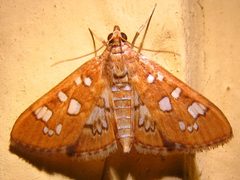
Forewings are pale whitish to cream-colored with prominent dark brown to blackish longitudinal stripes and bands. A distinctive dark band runs across the wing, with additional dark markings near the wing base and apex. Hindwings are paler, usually whitish or pale gray, with reduced patterning. Wingspan approximately 15–20 mm. Body is slender with pale scaling.
Habitat
Found in open including coastal scrub, chaparral, grasslands, and disturbed areas where plants occur. Often associated with riparian corridors and wetland edges where Baccharis grow.
Distribution
Widespread in North America, documented across the United States from the Atlantic Coast to the Pacific Coast, and southward into Mexico. Particularly common in the southern and western United States.
Seasonality
have been recorded throughout much of the year in warmer regions, with peak activity in spring and summer months. Multiple per year likely occur in southern portions of the range.
Diet
Larvae feed on of Baccharis (Asteraceae), including Baccharis halimifolia and related species. feeding habits are not well documented.
Host Associations
- Baccharis halimifolia - larval plant
Life Cycle
Complete with , larval, pupal, and stages. Larvae are stem borers or feed on leaves and stems of plants. occurs in silk webbing or within plant material.
Behavior
are and attracted to light. Larvae are concealed feeders within plant tissues.
Ecological Role
Larval herbivore on Baccharis ; may contribute to of this widespread shrub . Serves as prey for including birds, bats, and spiders.
Human Relevance
No significant economic impact. Occasionally encountered by gardeners and naturalists. Used as a research subject for studies of plant-insect interactions involving Baccharis.
Similar Taxa
- Diastictis ventralisSimilar wing pattern but differs in details of dark banding and geographic distribution; genitalia dissection often required for separation
More Details
Etymology
The specific epithet baccatalis derives from Baccharis, the of larval plants, with the Latin suffix -alis indicating relationship or pertaining to.