
Donacaula roscidellus
Dyar, 1917
Brown Donacaula Moth
Donacaula roscidellus is a crambid in the Schoenobiinae, described by Harrison Gray Dyar Jr. in 1917. It is distributed across the southeastern United States and eastern Mexico. The exhibits a relatively broad season, with active from late winter through late autumn.
Pronunciation
How to pronounce Donacaula roscidellus: //dɔˈnaːkaʊlə rɒsˈsɪdɛləs//
These audio files are automatically generated. While they are not always 100% accurate, they are a good starting point.
Identification
Distinguished from other Donacaula by forewing length of 18–30 mm and geographic distribution in the southeastern United States and eastern Mexico. The specific epithet and original description by Dyar (1917) provide taxonomic differentiation from . Accurate identification may require examination of genitalia or comparison with .
Images
Appearance
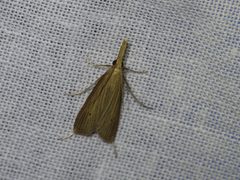
are medium-sized crambid with forewings measuring 18–30 mm in length. The "brown donacaula moth" suggests brownish coloration, though specific pattern details are not documented in available sources.
Distribution
Mexico (Veracruz) and the United States (Florida, Kentucky, Louisiana, Mississippi, Texas). Records indicate a southeastern U.S. distribution with a disjunct or peripheral in Kentucky.
Seasonality
recorded on wing from February to November, indicating a broad season spanning late winter through late autumn.
Similar Taxa
- Other Donacaula species share similar and preferences; D. roscidellus is distinguished by the combination of forewing length (18–30 mm), geographic range, and original description details.
More Details
Taxonomic History
Originally described by Harrison Gray Dyar Jr. in 1917. The has been recorded from 38 iNaturalist observations as of source date.