
Donacaula
Meyrick, 1890
Species Guides
24- Donacaula albicostellus(White-edged Donacaula)
- Donacaula aquilellus
- Donacaula dispersellus(Wandering Donacaula)
- Donacaula longirostrallus(Long-beaked Donacaula Moth)
- Donacaula maximellus
- Donacaula melinellus(Delightful Donacaula Moth)
- Donacaula n-sp-eight
- Donacaula n-sp-five
- Donacaula n-sp-four
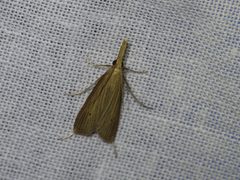
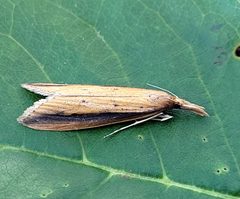
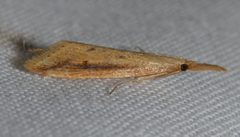
Donacaula is a of grass moths in the Crambidae, Schoenobiinae, established by Edward Meyrick in 1890. The genus comprises approximately 38 described distributed across all major biogeographic regions except Australia, with the highest diversity in the Nearctic region (21 species). Species are associated with wetland and riparian , where larvae bore into stems of grasses, sedges, and rushes.
Pronunciation
How to pronounce Donacaula: //dɔˈnæk.jʊ.lə//
These audio files are automatically generated. While they are not always 100% accurate, they are a good starting point.
Identification
Members of Donacaula can be distinguished from related Schoenobiinae by a combination of genitalic characters and wing pattern features. Specific diagnostic traits require examination of genitalia; the genus is not reliably separable from superficially similar crambid genera based on external alone.
Images
Habitat
Wetland and riparian environments including saltmarshes, marshes, lake margins, and watercourses. Vegetation include halophytic and hygrophilous associations with Poaceae, Juncaceae, and Cyperaceae. One (D. niloticus) has been documented in hyperhalophilic Mediterranean-Ibero-Atlantic thermomediterranean saltmarsh vegetation with mixed salty and fresh waters.
Distribution
excluding Australia. Nearctic: 21 ; Neotropical: 7 species; Palearctic: 4 species; Africa: 4 species; Oriental: 2 species. Documented from North America (including Vermont), Europe (Denmark, Norway, Sweden, Spain, southeastern Europe), Middle East, Turkey, Central Asia, northern India, China, and North Africa (Morocco, Algeria, Libya, Egypt).
Seasonality
of at least some fly in multiple from April to September. Specific periods vary by species and region.
Host Associations
- Phragmites australis - larval -level association for Donacaula, not confirmed for all
- Glyceria spp. - larval -level association for Donacaula, not confirmed for all
- Carex spp. - larval -level association for Donacaula, not confirmed for all
Life Cycle
Larvae are stem borers in grasses, sedges, and rushes, living in the lower portion of stems. Larval presence is indicated by a small round hole in the stem five to eight centimetres above the root. occurs at the base of the stem. Semi-aquatic larvae possess adaptations allowing proximity to water. Development includes complete with , larval, pupal, and stages.
Behavior
Larvae bore into stems of hygrophilous Poaceae, Juncaceae, and Cyperaceae. rest on grasses, rushes, or sedges. At least one has been collected using light traps.
Similar Taxa
- Other Schoenobiinae generaSimilar external ; reliable separation requires genitalic examination
More Details
Genetic divergence
COI mitochondrial sequences of D. niloticus show 11.8-13% divergence from other European and North American Donacaula , indicating substantial genetic differentiation within the .
Taxonomic note
Ten additional were described in an unpublished 2010 doctoral dissertation by Edda Lis Martínez and are not formally recognized.