
Saucrobotys futilalis
Lederer, 1863
dogbane saucrobotys moth, dogbane webworm
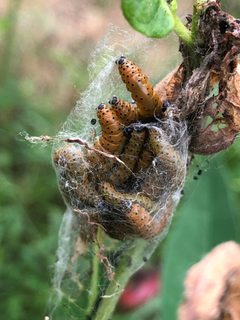
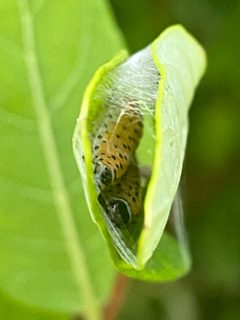
Saucrobotys futilalis, commonly known as the dogbane saucrobotys or dogbane webworm, is a crambid moth native to North America. The is notable for its specialized relationship with dogbane (Apocynum) and milkweed (Asclepias) plants, which serve as exclusive larval . Larvae construct silken nests on host plants and exhibit a striking ontogenetic color change from cryptic green to aposematic orange with black spots as they mature. Both larval and stages sequester cardiac glycosides from their host plants for chemical defense against . The species has been recorded across a broad geographic range from northeastern North America to British Columbia and south to Texas and California.
Pronunciation
How to pronounce Saucrobotys futilalis: //saʊkˈroʊbəˌtɪs fjuˈtɪlɪs//
These audio files are automatically generated. While they are not always 100% accurate, they are a good starting point.
Identification
Larvae can be distinguished from other dogbane-feeding insects by their silken nest construction and characteristic color progression from green to orange with black spots. The combination of web-building and aposematic orange-and-black coloration in mature larvae separates S. futilalis from the co-occurring dogbane leaf beetle (Chrysochus auratus), which is metallic blue-green and does not produce silk. The may be confused with other crambid larvae on milkweeds, but the specific association with dogbane and the distinctive nest architecture aid identification. require dissection or genital examination for definitive identification.
Images
Habitat
Found in meadows, roadsides, and forest edges where plants grow. Dogbane (Apocynum cannabinum) occurs in open, sunny including disturbed areas and rights-of-way. The thrives in early successional habitats and areas with abundant dogbane or milkweed vegetation.
Distribution
North America: recorded from northeastern United States and adjacent Canada west to British Columbia, and south to Texas and California. Two recognized reflect geographic variation: S. f. futilalis (Quebec to Manitoba, Illinois, New Jersey, Pennsylvania) and S. f. inconcinnalis (Alberta and British Columbia to California, Arizona, Texas).
Seasonality
are active from May to July. Larval development occurs during summer months when plants are in active growth. The likely has a single per year in most of its range, though precise data are limited.
Diet
Larvae feed exclusively on Apocynum (including A. cannabinum) and Asclepias species (including A. tuberosa). Both contain cardiac glycosides (cardenolides) that larvae sequester for defense. do not feed; they rely on larval reserves.
Host Associations
- Apocynum cannabinum - larval common dogbane; primary plant
- Apocynum androsaemifolium - larval spreading dogbane; secondary
- Asclepias tuberosa - larval weed; secondary
Life Cycle
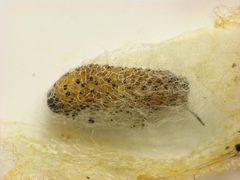
Complete with four stages: , larva, pupa, . Larvae hatch and immediately begin constructing silken webs on plants. They feed communally within these nests, which expand as larvae grow. Mature larvae likely pupate within or near the nest, though specific site documentation is limited. Adults emerge in late spring to midsummer. stage is inferred to be pupal or egg based on related crambid , but not confirmed.
Behavior
Larvae are gregarious web-builders, constructing and expanding silken nests throughout development. When threatened, caterpillars regurgitate gut contents containing sequestered cardiac glycosides as a chemical defense against . This has been experimentally demonstrated to repel predators. The ontogenetic shift from cryptic green to aposematic orange coloration correlates with increased nest size and reduced reliance on hiding, suggesting a behavioral transition from to active advertisement of unpalatability.
Ecological Role
As a herbivore, S. futilalis contributes to top-down pressure on dogbane and milkweed . The serves as a model for studying of plant secondary metabolites and the evolution of aposematism. Larvae and their webs provide food and for insectivorous birds, predatory insects, and , though their chemical defenses reduce pressure. The species participates in the complex of milkweed and dogbane specialists that includes , milkweed beetles, and other chemically defended herbivores.
Human Relevance
Minor economic significance; larvae can defoliate ornamental dogbane plantings. The has no known agricultural impact. Of interest to ecologists studying plant-insect chemical interactions and aposematism evolution. Not a target for .
Similar Taxa
- Chrysochus auratusAlso feeds on dogbane, but is a (Chrysomelidae) with metallic blue-green coloration, no silk production, and different defensive chemistry (sequestered cardenolides in glands rather than gut regurgitation)
- Euchaetes egleMilkweed tussock moth larva; feeds on milkweeds and dogbanes, but has distinctive tufted black, white, and orange setae rather than smooth orange-and-black spotted body, and does not construct silken nests
- Other Crambidae larvaeMany pyraloid larvae produce silk, but S. futilalis is distinguished by specific association with Apocynum/Asclepias and characteristic aposematic coloration in mature larvae
More Details
Chemical defense research
Research by Dr. Jacqualine Grant demonstrated that the aposematic coloration of S. futilalis larvae serves as an honest signal of chemical defense, with simulated predatory attacks triggering regurgitation of cardiac glycoside-laden gut contents that repel .
Co-occurrence with dogbane leaf beetle
S. futilalis frequently co-occurs with Chrysochus auratus on dogbane plants, representing two independent evolutionary solutions to the challenge of exploiting chemically defended : the uses and glandular storage, while the uses web-building and aposematic warning coloration with gut regurgitation.
Sources and further reading
- BugGuide
- Wikipedia
- GBIF taxonomy match
- iNaturalist taxon
- NCBI Taxonomy
- Catalogue of Life
- Archive — Bug of the Week
- Bane of dogbane, the beautiful and the ugly: Dogbane leaf beetle, Chrysochus auaratus, and dogbane webworm, Saucrobotys futilalis — Bug of the Week
- Guest Blogger: Dogbane for Dinner | Beetles In The Bush