
Pyrausta inveterascalis
Barnes & McDunnough, 1918
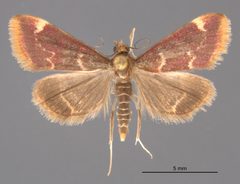
Pyrausta inveterascalis is a small crambid described in 1918. have a wingspan of approximately 15 mm with dull vinous forewings featuring a narrow yellow terminal band and smoky hindwings. The occurs in eastern North America from western Pennsylvania to southern Ontario, Illinois, and Missouri. Larvae feed on Monarda species.
Pronunciation
How to pronounce Pyrausta inveterascalis: /pɪˈraʊstə ɪnˌvɛtərəˈskælɪs/
These audio files are automatically generated. While they are not always 100% accurate, they are a good starting point.
Identification
Small size (~15 mm wingspan) and dull vinous forewings with contrasting narrow yellow terminal band separate this from most similar Pyrausta . Smoky hindwings also distinctive. Larvae are small, creamy-colored caterpillars found feeding within Monarda flower buds, producing characteristic black pellets.
Images
Appearance
Wingspan approximately 15 mm. Forewings dull vinous with narrow terminal yellow area. Hindwings smoky.
Distribution
Eastern North America: western Pennsylvania to southern Ontario, Illinois, and Missouri.
Diet
Larvae feed on Monarda (beebalm, wild bergamot). : unknown.
Host Associations
- Monarda - larval food plantMultiple including spotted beebalm, scarlet beebalm, and wild bergamot
Ecological Role
Larval feeding within Monarda flower buds can destroy floral display, reducing nectar resources for and other beneficial insects.
Human Relevance
Considered a garden pest of Monarda . Larval damage to flower buds reduces blooming. Control through mechanical removal of caterpillars or targeted application of Bacillus thuringiensis kurstaki (Btk) or spinosad (with caution regarding ).
Similar Taxa
- Pyrausta signatalisAlso feeds on Monarda; raspberry pyrausta has more contrasting wing pattern with brighter coloration
- Other Pyrausta speciesP. inveterascalis distinguished by small size, dull vinous ground color, and specific yellow terminal band on forewings