
Portentomorphini
Amsel, 1956
Genus Guides
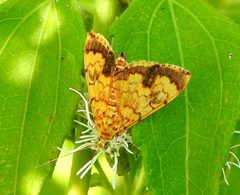
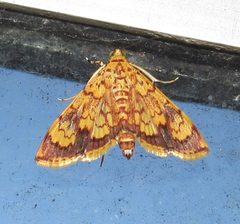
1Portentomorphini is a tribe of small crambid in the Pyraustinae, characterized by distinctive genital . have forewings 7.5–9.5 mm long with yellow maculation and often red or orange postmedial areas. The tribe contains 44 across six and was reinstated as a valid tribe in 2019 based on phylogenetic evidence, though its position within Pyraustinae remains under study. Caterpillars primarily feed on plants in the Phyllanthaceae.
Pronunciation
How to pronounce Portentomorphini: //pɔːrˌtɛntoʊˈmɔːrfɪnaɪ//
These audio files are automatically generated. While they are not always 100% accurate, they are a good starting point.
Identification
Distinguished from other Pyraustinae by unique male genitalia: detached and projecting freely dorsally with setose apex, reduced valva with large sacculus, and presence of curved fibula. Female genitalia with appendix bursae and variable signum structure. External appearance of yellow forewings with red/orange postmedial area is suggestive but not diagnostic without genital examination.
Images
Appearance
are relatively small with forewing length 7.5–9.5 mm (wingspan 20–29 mm). Forewings typically yellow with distinct red or orange postmedial (outer) area. Male genitalia unique among Pyraustinae: detached from valva and projecting freely dorsally with setose apex; valva reduced to large membranous sacculus extending outward with setose terminal field; thin elongate often articulated curved fibula emerging from valva edge. Female genitalia with membranous appendix bursae at end of ductus bursae (laterally attached to corpus bursae in Pioneabathra); signum shape variable—four-armed star in Hyalobathra and Cryptosara, elongate ovoid in Portentomorpha, two large opposing granulose areas in Pioneabathra and Isocentris filalis.
Habitat
Tropical and subtropical regions; one (Hyalobathra intermedialis) recorded from montane at 1,700 m elevation in Qin Mountains, China.
Distribution
Tropics and subtropics of Australia, Africa, Asia, South America, and Central America. Montane exception in Central China (Shaanxi province).
Diet
Caterpillars primarily feed on Phyllanthaceae: Margaritaria nobilis (Portentomorpha xanthialis), Glochidion and Phyllanthus (Hyalobathra), Flueggea (Pioneabathra olesialis, Isocentris filalis), Phyllanthus urinaria (Mabra eryxalis). Additional recorded : Euphorbia virosa (Euphorbiaceae), Sphaeranthus indicus (Asteraceae), Abrus precatorius (Fabaceae), Helianthus annuus (Asteraceae), Solanum (Solanaceae), and rice (Poaceae).
Host Associations
- Margaritaria nobilis - food plantPortentomorpha xanthialis
- Glochidion - food plantHyalobathra
- Phyllanthus - food plantHyalobathra , Mabra eryxalis
- Flueggea - food plantPioneabathra olesialis, Isocentris filalis
- Euphorbia virosa - food plantIsocentris
- Sphaeranthus indicus - food plantIsocentris
- Abrus precatorius - food plantHyalobathra
- Helianthus annuus - food plantHyalobathra
- Solanum - food plantPioneabathra olesialis
- Oryza sativa - food plantMabra eryxalis
Human Relevance
Mabra eryxalis has been recorded feeding on rice, indicating potential agricultural relevance.
Similar Taxa
- PyraustiniPortentomorphini has been found nested within Pyraustini in some phylogenetic studies, rendering Pyraustini ; distinguished by the unique genital synapomorphies of Portentomorphini
- Other Pyraustinae tribesLack the distinctive male genitalia with detached , reduced valva with large sacculus, and curved fibula characteristic of Portentomorphini
Misconceptions
Long treated as a synonym of Pyraustinae due to lack of phylogenetic study; reinstated as valid tribe in 2019, though 2022 study suggests it may render Pyraustini .
More Details
Systematic history
Erected by Hans Georg Amsel in 1956 based on Portentomorpha. Long synonymized with Pyraustinae. Reinstated 2019 based on monophyly of Portentomorpha, Cryptosara, and Hyalobathra. 2022 study found Portentomorphini nested within Pyraustini.
Included genera
Six with 44 : Cryptosara (3 spp.), Hyalobathra (21 spp.), Isocentris (8 spp.), Mabra (9 spp.), Pioneabathra (2 spp.), Portentomorpha (1 sp.)