
Hellula rogatalis
Hulst, 1886
Cabbage Webworm, Cabbage Webworm Moth
, commonly known as the cabbage webworm, is a small crambid native to North America. The is a significant agricultural pest whose larvae feed on Brassicaceae crops and related plants. are active from spring through fall, with multiple occurring annually in southern regions. The species was first described by George Duryea Hulst in 1886.
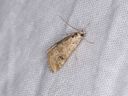
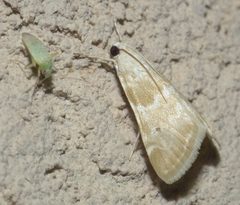
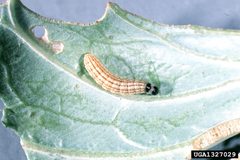
Pronunciation
How to pronounce Hellula rogatalis: //hɛˈluːlə roʊˈɡætəlɪs//
These audio files are automatically generated. While they are not always 100% accurate, they are a good starting point.
Identification
Distinguished from similar crambid by the combination of yellowish forewings with three wavy white transverse lines and the characteristic subterminal line of equally spaced black dots. The small size (15–21 mm wingspan) and geographic range help separate it from related Hellula . Larvae are identified by their silken webbing on Brassicaceae plants and feeding damage concentrated on leaf buds and young leaves.
Images
Appearance
have a wingspan of 15–21 mm. Forewings are brownish yellow to grayish yellow with wavy white antemedial, , and postmedial lines. The subterminal line is marked by several equally spaced black dots. Hindwings are light gray to grayish yellow with a dark terminal line and pale fringe. Larvae are not described in available sources.
Habitat
Associated with agricultural and disturbed where Brassicaceae plants grow. Larvae require host plants for development; are found in fields, gardens, and areas with abundant cruciferous vegetation.
Distribution
Native to North America. In the United States, occurs from the southern states northward along the eastern seaboard to Maryland, New York, and Ontario, Canada. Also recorded from the Distrito Federal in Mexico.
Seasonality
are active from late March to October in southern regions and from June to October in northern portions of the range. Multiple occur per year in the south; generation number decreases northward.
Diet
Larvae feed on leaf buds and young leaves of Brassicaceae and related , including cabbage, turnip, beet, collard, cauliflower, kale, rutabaga, radish, kohlrabi, mustard, rape, horseradish, shepherd's purse (Capsella bursa-pastoris), and purslane (Portulaca oleracea). feeding habits are not documented.
Host Associations
- Brassica oleracea - larval food plantcabbage, cauliflower, kale, collard
- Brassica rapa - larval food plantturnip
- Brassica napus - larval food plantrape, rutabaga
- Raphanus sativus - larval food plantradish
- Armoracia rusticana - larval food planthorseradish
- Capsella bursa-pastoris - larval food plantshepherd's purse
- Portulaca oleracea - larval food plantpurslane
- Beta vulgaris - larval food plantbeet
Life Cycle
Multiple per year in southern range; fewer in north. stage not explicitly documented in sources. Complete with , larval, pupal, and stages.
Behavior
Larvae construct silken webs on plants for shelter while feeding. Feeding is concentrated on leaf buds and young leaves, causing damage to growing points of plants.
Ecological Role
Herbivore; acts as a primary consumer in agricultural . are tied to availability of Brassicaceae plants.
Human Relevance
Significant agricultural pest of Brassicaceae vegetable crops. Larval feeding damages leaf buds and young leaves, reducing crop yield and quality. Management is required in commercial vegetable production.
Similar Taxa
- Hellula hydralisRelated congeneric with overlapping plant use; distinguished by distribution and subtle wing pattern differences
- Hellula undalisRelated congeneric ; distinguished by distribution and wing pattern characteristics
More Details
Original Description
First described as Botys rogatalis by George Duryea Hulst in 1886, later transferred to Hellula