
Crambus praefectellus
Zincken, 1821
common grass-veneer, silver-striped webworm
A small grass moth in the Crambidae, widespread across eastern North America. are active from spring through fall, with extended or year-round activity in the southernmost parts of its range. Larvae develop within silken webs on grasses and cereal grains.

Pronunciation
How to pronounce Crambus praefectellus: /ˈkræmbʊs priːfɛkˈtɛləs/
These audio files are automatically generated. While they are not always 100% accurate, they are a good starting point.
Identification
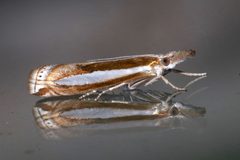
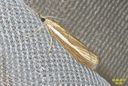
Distinguished from other Crambus by the combination of silvery longitudinal forewing stripes and the specific pattern of striping. Similar species in the may share general grass-veneer but differ in precise stripe arrangement and width. Genitalia examination may be required for definitive identification of similar .
Images
Appearance
Small with wingspan 18–25 mm. Forewings narrow and elongated, held tightly against body at rest, giving a slender cylindrical profile. Coloration pale with silvery longitudinal stripes. Hindwings narrower than forewings, pale grayish.
Habitat
Grasslands, meadows, agricultural fields, lawns, and other areas with abundant grasses. Associated with both native and cultivated grass .
Distribution
Eastern North America: United States and southern Canada east of the Rocky Mountains. Documented from Alberta, Manitoba, and Vermont; inferred present throughout intervening regions based on continuous range description.
Seasonality
activity period varies by latitude: May to September in northern range, April to October in mid-latitudes, and likely year-round in southern Florida and Texas.
Diet
Larvae feed on various grasses (Poaceae) and cereal grains. Specific grass not documented in available sources.
Life Cycle
Complete with larval stage developing within silken webbing on grasses. presumably occurs in or near larval feeding site, though specific details of pupal not documented. Multiple per year likely in southern portions of range.
Behavior
Larvae construct silken webs on grasses for shelter while feeding. are and attracted to light.
Ecological Role
Herbivore in grassland ; larval feeding may contribute to nutrient cycling in grass . Potential minor pest of cereal crops.
Human Relevance
Occasional pest of cereal grains; 'silver-striped webworm' references larval web-building habit on economically important grasses. Attracted to artificial light sources.
Similar Taxa
- Other Crambus speciesShare grass-veneer and grass-feeding habits; require examination of wing pattern details or genitalia for separation
More Details
Etymology
Specific epithet 'praefectellus' is a diminutive form, possibly referencing the small size or some aspect of the ' appearance compared to related .
Taxonomic history
Described by Zincken in 1821, making it one of the earlier described in the Crambus.