
Mesolia
Ragonot, 1889
Species Guides
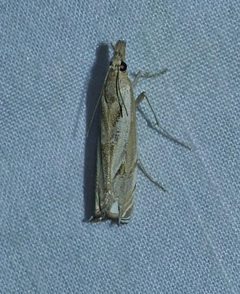
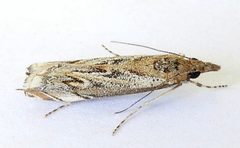
4Mesolia is a of grass moths in the Crambidae, Crambinae. The genus was established by Émile Louis Ragonot in 1889 and contains approximately 20 described distributed across the Americas, with some species extending to the Caribbean and Old World tropics. Members of this genus are characterized by distinctive wing venation patterns and specialized palpal structures. The genus is taxonomically stable and well-represented in collections, though biological details for most species remain poorly documented.
Pronunciation
How to pronounce Mesolia: /mɛˈsoʊliə/
These audio files are automatically generated. While they are not always 100% accurate, they are a good starting point.
Identification
Distinguished from related crambine by the combination of: (1) porrect, densely hairy labial palpi extending well beyond ; (2) conical projection; (3) absence of 3 in both forewing and hindwing; (4) stalked veins 7–9 in forewing; and (5) anastomosis of veins 7 and 8 in hindwing. The asymmetrical tibial spurs (outer about half length of inner) provide additional diagnostic characters. -level identification requires examination of genitalia and wing pattern details; several species are externally similar and have been historically confused.
Images
Appearance
Medium to small crambid with narrow, elongate forewings and rounded apices. Labial palpi porrect (projecting forward), thickly clothed with hair, and extending approximately twice the length of the . Maxillary palpi triangularly scaled. with a prominent conical projection. Male thickened and flattened. Tibial spurs asymmetrical, with outer spurs about half the length of inner spurs. Forewing venation diagnostic: 3 absent, veins 4 and 5 arising from angle of , veins 7–9 stalked, veins 10 and 11 free; outer margin produced from apex to vein 5. Hindwing with vein 3 absent, veins 4 and 5 from angle of cell, vein 6 from upper angle; upper margin of cell widely separated from vein 8, with vein 7 curving upward to anastomose with vein 8.
Habitat
Grassland and open vegetation , including prairies, savannas, and agricultural fields. Associated with herbaceous vegetation, particularly grasses (Poaceae). Specific microhabitat preferences vary by ; some occur in arid grasslands, others in mesic meadows.
Distribution
Primarily New World distribution with center of diversity in North and Central America. Records from southwestern United States (Arizona, New Mexico, Texas), Mexico, Central America, and South America. Disjunct occur in the Caribbean (Jamaica) and Old World tropics (species with African and Oriental distributions, e.g., M. plurimellus, M. uniformella).
Seasonality
activity patterns vary by and latitude; most North American species fly from late spring through summer (May–August). Tropical species may be multivoltine with adults present year-round. Larval stages likely occur during periods of active grass growth.
Host Associations
- Poaceae - probable larval Inferred from Crambinae ; direct records for Mesolia are sparse.
Behavior
Ecological Role
Larvae likely function as primary consumers in grassland , potentially affecting grass productivity. Specific ecological impacts undocumented. serve as prey for including bats and birds.
Human Relevance
No documented economic importance. Not known as agricultural pests, though some occur in agricultural landscapes. Of interest to lepidopterists and biodiversity researchers documenting grassland faunas.
Similar Taxa
- CrambusSimilar grass moth and , but Crambus typically have 3 present in forewing and lack the pronounced conical projection of Mesolia.
- AgriphilaOverlapping distribution and grassland ; distinguished by different wing venation ( 3 present) and less prominent labial palpi.
- FissicrambusShares narrow wing shape and grassland association; differs in forewing venation with 3 present and different palpal structure.
More Details
Taxonomic stability
The Mesolia has remained taxonomically stable since its description, with no major synonymies or revisions. The most recent description is M. meyi Bassi, 2013 from South America.
Collection representation
The is represented by 281 observations on iNaturalist and well-represented in major museum collections, though many remain known from few specimens.