
Elophila obliteralis
(Walker, 1859)
Waterlily Leafcutter Moth
Elophila obliteralis is a small aquatic native to eastern North America, with introduced in Hawaii, South Africa, and England. have a wingspan of 10–22 mm and are active from May to August. The larvae are aquatic, feeding on diverse aquatic plants and constructing protective cases from cut leaf pieces held together with silk. The has been investigated as a agent for aquatic plants including Nymphoides peltata and Hygrophila polysperma.
Pronunciation
How to pronounce Elophila obliteralis: /ɛˈlɒfɪlə ɒˌblɪtəˈreɪlɪs/
These audio files are automatically generated. While they are not always 100% accurate, they are a good starting point.
Identification
Small crambid with aquatic larvae; recognized by association with aquatic and seasonal activity May–August. Larvae distinguished by case-building using silk to bind cut plant fragments.
Images
Appearance
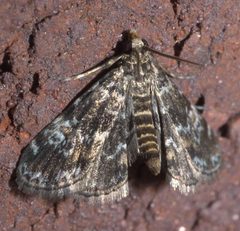
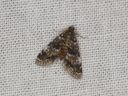
wingspan 10–22 mm; males smaller than females.
Habitat
Aquatic environments including ponds, lakes, wetlands, swamps, and slow-moving waters; larvae live underwater among floating-leaved aquatic plants.
Distribution
Native to eastern North America from Florida to Manitoba, Canada, and west to Texas. Introduced to Hawaii, South Africa (Eastern Cape, Gauteng, KwaZulu-Natal, Limpopo), England, and British Columbia.
Seasonality
active May to August in North America; larval stage aquatic and present during growing season.
Diet
Larvae feed on foliage of aquatic plants; range includes more than 60 . Documented hosts include Hydrilla verticillata, Eichhornia crassipes, Pistia stratiotes, Nymphaea species, Potamogeton species, Nymphoides peltata, and Hygrophila polysperma.
Host Associations
- Hydrilla verticillata - larval food plant
- Eichhornia crassipes - larval food plant
- Pistia stratiotes - larval food plant
- Nymphaea - larval food plant
- Potamogeton - larval food plant
- Nymphoides peltata - larval food plant; control target
- Hygrophila polysperma - larval food plant; control target
Life Cycle
laid on margins of aquatic plant leaves. Larvae aquatic: young instars construct water-filled cases anchored to plants with silk; older instars build free-floating cases containing air pockets. Prior to , larva reattaches case to host plant and spins silk cocoon within case. emerges from cocoon.
Behavior
Larvae cut pieces from plant foliage to construct portable protective cases, using silk to bind leaf fragments. Case-building strategy changes with development: anchored water-filled cases in early instars, free-floating air-pocket cases in later instars. Larvae anchor to substrate using silk threads.
Ecological Role
Herbivore of aquatic vegetation; investigated as agent for aquatic plants. Larval feeding can significantly reduce leaf surface area and impact plant regrowth.
Human Relevance
Studied as potential for aquatic plants Nymphoides peltata (yellow floating ) and Hygrophila polysperma. Has been introduced outside native range, including Hawaii and South Africa.
Similar Taxa
- Elophila turbataAquatic crambid with similar larval case-building ; distinguished by associations and geographic distribution.
Sources and further reading
- BugGuide
- Wikipedia
- GBIF taxonomy match
- iNaturalist taxon
- NCBI Taxonomy
- Death from below: the first video of a parasitic wasp attacking caterpillar underwater | Blog
- parasitic behavior | Blog
- The potential of Elophila obliteralis larvae (waterlily leafcutter moth) as a biological control for the invasive aquatic plant Nymphoides peltata (yellow floating heart)
- Waterlily Leafcutter, Synclita obliteralis (Walker) (Insecta: Lepidoptera: Crambidae: Acentropinae)
- Genomic resources of aquatic Lepidoptera, Elophila obliteralis and Hyposmocoma kahamanoa, reveal similarities with Trichoptera in amino acid composition of major silk genes.