
Petrophila jaliscalis
Schaus, 1906
Jalisco Petrophila
Petrophila jaliscalis is a small aquatic in the Crambidae, described by Schaus in 1906. The has a broad North American distribution spanning from Alberta, Canada through the western United States to Mexico. are active nearly year-round and have forewings measuring 7–11 mm. The larvae are aquatic and feed on .
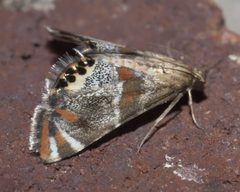
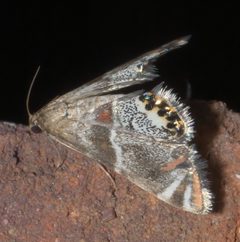
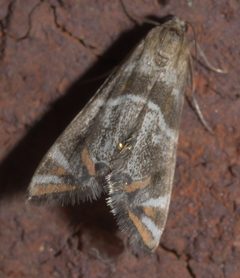
Pronunciation
How to pronounce Petrophila jaliscalis: /ˈpɛt.roʊˌfiː.lə ˌhæˈlɪ.sə.lɪs/
These audio files are automatically generated. While they are not always 100% accurate, they are a good starting point.
Identification
The combination of small size (forewings 7–11 mm), aquatic association, and broad western North American distribution helps distinguish this from other Petrophila. The Petrophila can be separated from similar crambid genera by the aquatic larval habit and associated . Specific diagnostic features for P. jaliscalis versus are not well documented.
Images
Appearance
Small with forewing length of 7–11 mm. have the typical Petrophila wing shape with somewhat triangular forewings. Coloration and pattern details are not well documented in available sources.
Habitat
Aquatic and riparian environments. Larvae develop in water, suggesting association with streams, ponds, or other freshwater . are found in areas near larval development sites.
Distribution
North America: Mexico (Jalisco), United States (Texas, Arizona, California), and Canada (Alberta). The broad latitudinal range from Alberta to Jalisco indicates adaptability to varied climatic conditions.
Seasonality
have been recorded on wing nearly year-round, indicating extended or continuous adult activity without strong seasonal restriction.
Diet
Larvae feed on . feeding habits are not documented.
Life Cycle
Aquatic larvae feed on . Developmental details and site are not documented. emerge and are active for extended periods.
Behavior
are attracted to light. Larvae are aquatic, an unusual habit among Lepidoptera that restricts this to freshwater .
Ecological Role
Larvae function as primary consumers in aquatic , feeding on . The contributes to nutrient cycling in freshwater environments and serves as prey for aquatic .
Human Relevance
No documented economic or medical significance. occasionally attracted to artificial lights. The has been recorded over 4,000 times on iNaturalist, indicating it is frequently encountered and photographed by naturalists.
Similar Taxa
- Other Petrophila speciesMultiple occur in overlapping ranges; separation requires examination of genitalia or detailed wing pattern analysis
- Other AcentropinaeSeveral crambid share aquatic larvae; may be confused without close examination of wing venation and genitalia
More Details
Taxonomic history
Described by Schaus in 1906 based on material from Jalisco, Mexico. The epithet reflects this type locality.
Observation frequency
With over 4,100 iNaturalist observations, this is among the more frequently documented aquatic in western North America, likely reflecting both its abundance and the conspicuousness of at lights.